China’s spacecraft reaches asteroid that may be a piece of the moon

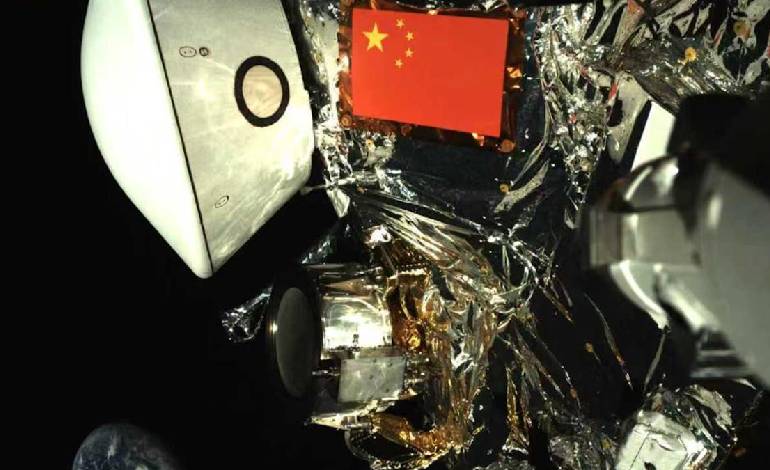
China’s Tianwen-2 spacecraft has arrived at asteroid Kamoʻoalewa, one of Earth’s “quasi-moons,” to collect samples and solve a long-running mystery about its origin.
Kamoʻoalewa is a small asteroid, about 40 to 100 meters wide, that orbits the Sun in a path close to Earth. For years scientists believed it could be a fragment blasted off the Moon by an ancient impact, because its surface spectrum closely matched lunar rocks.
But a new study suggests it may be an ordinary asteroid instead. Researchers found its light signature matches common stony meteorites, and its red color could be due to space weathering rather than a lunar origin.
Launched in May 2025, Tianwen-2 entered orbit around the asteroid in early June 2026. In the coming weeks it will attempt to collect samples using touch-and-go or anchor methods, similar to NASA and JAXA missions.
If the material returned to Earth in late 2027 matches Moon rocks, the “lunar fragment” theory will be proven. If not, it will show that space weathering can make asteroids look like the Moon.
The mission is also testing China’s deep-space technology for future Moon and Mars sample returns. Scientists say the results will help improve models of how collisions shaped the solar system.