Tagged Olive Ridley travels 6,719 km, reveals Odisha coast’s hidden turtle highways

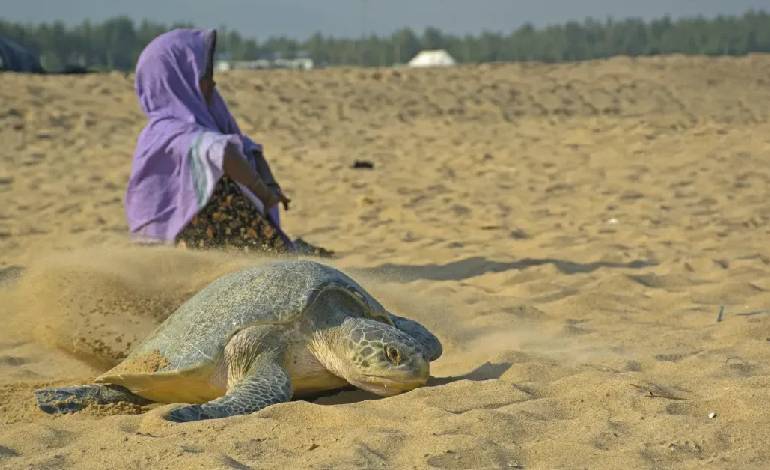
Bhubaneswar: Every year Olive Ridley turtles return to Odisha’s coast to nest, but much of their journey happens offshore, out of sight.
A three-year research initiative led by the Dehradun-based Wildlife Institute of India (WII) is now following the turtles beyond the shoreline to answer where they travel, how long they stay close to the coast and which stretches of the Bay of Bengal they depend on.
The first-year report of the study, released by Forest Minister Ganesh Ram Singh Khuntia, combines satellite telemetry with boat-based surveys and shoreline analysis.
Initial fieldwork focused on the Gahirmatha rookery in Kendrapara district, while satellite tagging was carried out at both Gahirmatha and Rushikulya in Ganjam district.
Early results show males and females do not follow the same patterns. Male turtles began their offshore migration earlier, while females spent longer periods in nearshore waters. Tracking also indicated possible foraging stopovers along the continental shelf.
One tagged female covered 6,719 km over 271 days, eventually reaching waters east of Sri Lanka. Another travelled nearly 200 km from Gahirmatha to Rushikulya and then returned, showing that turtles move between different parts of Odisha’s coastline rather than remaining tied to a single nesting site.
During the 2025-26 nesting season, boat-based surveys recorded 1,390 individual Olive Ridleys and 67 mating pairs, with most sightings within two kilometres of the coastline, indicating that nearshore waters are critical in the period leading up to nesting.
Odisha is home to two of India’s best-known mass-nesting sites, Gahirmatha and Rushikulya. The species is protected under Schedule I of the Wildlife Protection Act, 1972.
Researchers say protecting nesting beaches alone may not account for the habitats turtles depend on before they arrive, and the study could help inform better conservation planning.