UT Austin engineers develop jacket that pulls drinking water from air

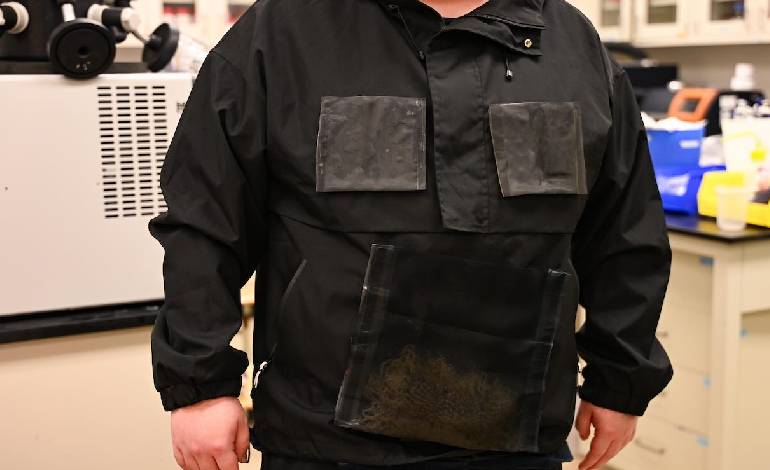
AUSTIN, Texas: Engineers at the University of Texas at Austin have developed a high-tech jacket that can harvest up to one-and-a-half pints of drinking water per day directly from the air.
The breakthrough centers on a new fabric technology rather than a bulky box or panel. “Water harvesting from air is usually imagined as a stationary device such as a box, a panel. We wanted to rethink the form,” said research co-leader Professor Guihua Yu.
The textile incorporated into the jacket collects atmospheric moisture and funnels it to detachable harvesting units. Those units are then “placed in a foldable collector and heated to produce the water,” Yu explained.
In testing, the jacket produced between 400 and 900 milliliters of drinkable water per day, depending on humidity levels. The findings were published in the journal Science Advances.
Compared with conventional water-harvesting materials, the textile showed a three- to 10-fold improvement at scale.“The important advance here is that the team did not simply make another material that absorbs water,” said study co-author Professor Keith Johnston. “They designed a pathway for water to move quickly, from vapor in the air to liquid on the fiber surface, and then into the interior of the textile.”
Researchers say the technology could benefit hikers, campers, runners, agricultural workers, and soldiers who spend extended time without easy access to drinking water.
The team is now exploring applications beyond clothing, including backpacks, tents, emergency shelters, and other outdoor gear. They also plan to study use in remote field operations, disaster response, and water access in arid or infrastructure-limited regions.
A separate solar-powered device developed by the same group captured 1.3 liters of clean water per day in both the Chihuahuan Desert and Austin, Texas. That equals 4.3 liters of water per kilo of moisture-capturing material daily, which the team says is more than any other research group has achieved. Those results appeared in the journal Nature Water.