Bumblebees learn ‘Morse code’ rhythms, showing surprising sense of timing

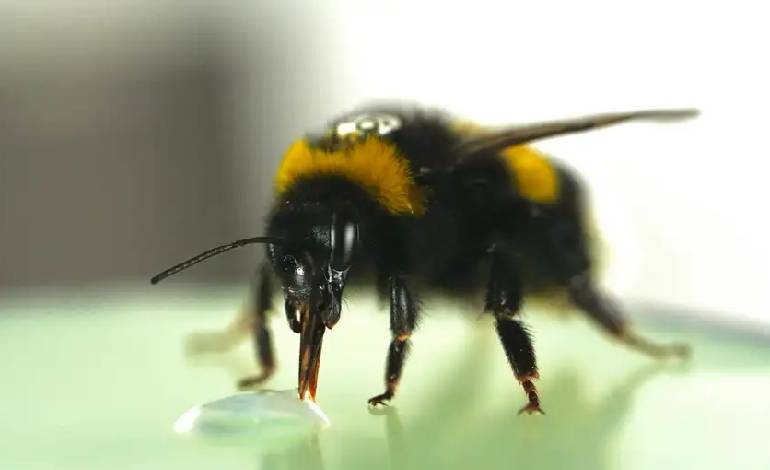
Researchers at Queen Mary University of London have found that bumblebees Bombus terrestris can learn to recognise Morse code-like sequences of flashing lights and vibrations. The discovery demonstrates a sense of rhythm that has never been seen before in such a small-brained animal.
PhD student Alex Davidson and Dr. Elisabetta Versace, Senior Lecturer in Psychology, led the team. They built a special maze where individual bees encountered two flashing circles: one with a short flash “dot” and one with a long flash “dash”. When the short flash was paired with sugar, the long flash led to a bitter quinine solution that bees dislike.
To make sure the bees weren’t relying on location, the positions of the dot and dash were changed in each room of the maze. After bees learned to fly straight to the sugar-paired flash, the team removed the sugar. Most bees still chose the correct duration even in new positions, confirming they had learned timing rather than scent or place.
The scientists then increased the complexity. Bees could distinguish patterns like “dash dash dot dot” versus “dot dash dot dash”. When the tempo was sped up or slowed down, the bees still differentiated between them. That showed they had learned a flexible rhythm regardless of speed.
“We wanted to find out if bumblebees could learn the difference between these different durations, and it was so exciting to see them do it,” Davidson said.
In another test, researchers replaced flashing lights with a vibrating floor at a maze junction. One rhythm — “dot dash dot dash” — meant turn right for sugar; another meant turn left. The bees learned that too.Until now, the ability to discriminate between dot and dash durations had only been seen in humans and a few other vertebrates such as macaques or pigeons.
The ability to recognise flexible, abstract rhythms has only been demonstrated in a few birds and mammals, including parrots, songbirds and primates like chimpanzees.
The findings suggest timing ability may be fundamental to nervous systems, even in insects with fewer than one million neurons. The study adds to earlier work showing bumblebees can do basic math, understand zero, and learn by watching others.