Scientists discover two ‘super-puff’ planets lighter than cotton candy

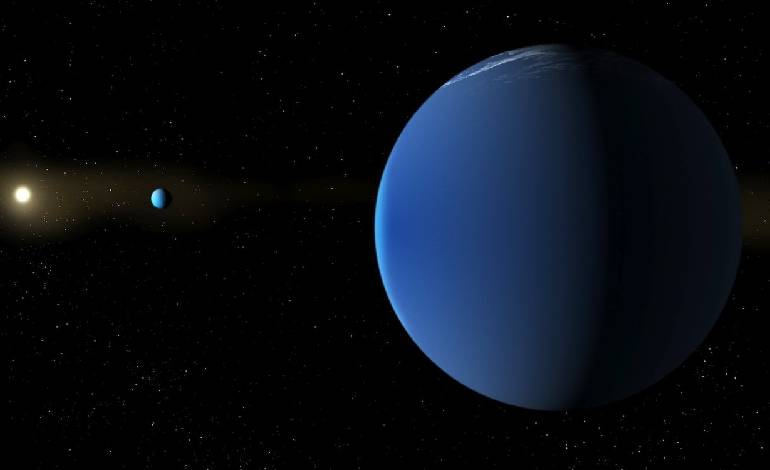
Oxford: Astronomers have discovered two giant “super-puff” planets with densities lower than cotton candy, orbiting a dwarf star 1,110 light years from Earth in the southern constellation of Volans.
The planets, named TOI-791b and TOI-791c, are roughly the size of Jupiter but “extraordinarily” diffuse, according to a new study published in the Monthly Notices of the Royal Astronomical Society.
Jupiter has a density of 1.33 grams per cubic centimeter. By comparison, TOI-791b measures just 0.038 grams per cubic cm and TOI-791c measures 0.047 grams per cubic cm. That makes them 28 to 35 times lighter than Jupiter and less dense than cotton candy, which is typically around 0.05 grams per cubic cm. Earth’s density is 5.5 grams per cubic cm.
“Only a handful of these super-puffy planets are known, and it is even rarer to find two in the same system,” said lead author Dr. George Dransfield from the University of Oxford. “Their extremely low densities make them fascinating targets for understanding how planetary systems form and evolve.”
The planets are believed to have formed together from the same disc of gas and dust around their young star. They are locked in a rare 5:3 mean-motion resonance, meaning for every five orbits of the inner planet, the outer planet completes almost exactly three. The gravitational interaction causes the planets to “tug” on one another, producing measurable shifts in the timing of their transits across the host star.
The pair were first flagged as possible planets by citizen-science volunteers with the Planet Hunters TESS project, which reviews NASA data for new worlds. Researchers then confirmed their sizes and masses using telescopes worldwide, including the Antarctic Search for Transiting ExoPlanets (ASTEP) telescope.
Antarctica’s months of continuous winter darkness proved critical. It allowed astronomers to capture the planets’ transits — each lasting more than 11 hours — in a single uninterrupted observation. Those are the longest continuous planetary transits ever observed in their entirety from the ground.
Transits occur when a planet passes in front of its star and slightly dims its light. The amount of dimming reveals the planet’s size. By analyzing subtle timing variations caused by the planets’ gravitational pull on each other, the team estimated their masses and calculated the low densities.
“Bringing together observations from Antarctica, space telescopes, and observatories across several continents was essential to revealing the true nature of these extraordinary planets,” said co-author Professor Tristan Guillot from the Université Côte d’Azur.
How super-puff planets form remains unclear. The team plans follow-up observations with the James Webb Space Telescope to test whether the planets’ puffy atmospheres contain carbon-, nitrogen-, and oxygen-bearing species. “We propose to carry out space-based observations using the James Webb Space Telescope to assess if the puffy atmosphere contains carbon-, nitrogen-, and oxygen-bearing species, revealing new insight into how these unusual planets formed,” said study co-author Professor Amaury Triaud from the University of Birmingham.