Perseverance marks 5 years on Mars, hits ‘marathon’ milestone with 26.2 miles driven

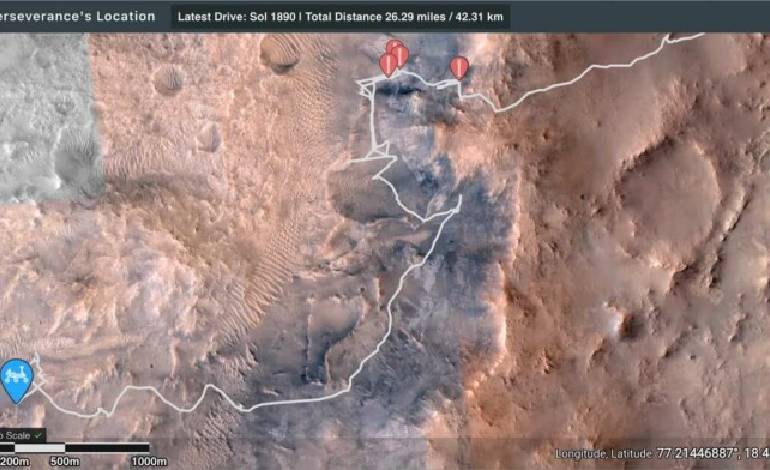
Pasadena, Calif.: NASA’s Perseverance rover just hit a marathon on Mars. The robotic science lab marked five years on the Red Planet after driving 26.2 miles across Jezero Crater and beyond.
Since landing in February 2021, Perseverance has run hundreds of experiments and helped confirm that Jezero Crater once held a lake. Drilling into the crater floor revealed lakebed sediments. In 2022, the rover climbed onto a 3-billion-year-old delta, where its RIMFAX radar peered 65 feet below the surface. The scans showed flat, horizontal layers — just like lake deposits on Earth.
The rover has also looked up. In 2022, its Mastcam-Z captured a solar eclipse as the potato-shaped moon Phobos passed in front of the sun. A solar filter allowed color and detail unmatched in past Mars eclipse footage.
By late 2023, Perseverance finished its crater survey and moved to the ancient river canyon feeding Jezero. Rich carbonate deposits along the margin, visible from orbit, could hold signs of ancient microbial life. “We picked Jezero Crater because orbital imagery showed a delta — clear evidence that a large lake once filled the crater,” said project scientist Ken Farley of Caltech. “A lake is a potentially habitable environment.”
In April 2025, after summiting the crater rim, the rover began its fastest sampling pace since landing. It has logged nearly 100 sampling efforts, including some of Mars’ earliest molten rock, underground boulders, and water-sculpted layered rocks. Some samples may be the oldest yet collected.
All tubes are stored in sterilized sapphire containers NASA calls the “cleanest surfaces in the universe.” But how they’ll get back to Earth is still undecided. The original sample-return plan ballooned to $11 billion, forcing NASA to seek cheaper, faster proposals from industry and academia.
NASA Administrator Jared Isaacman has floated sending astronauts to collect them by hand. Such a crewed Mars mission remains a long-term goal for NASA and SpaceX, which argues a robotic return would be redundant.