World’s first working nuclear clocks built by teams in Vienna and Beijing

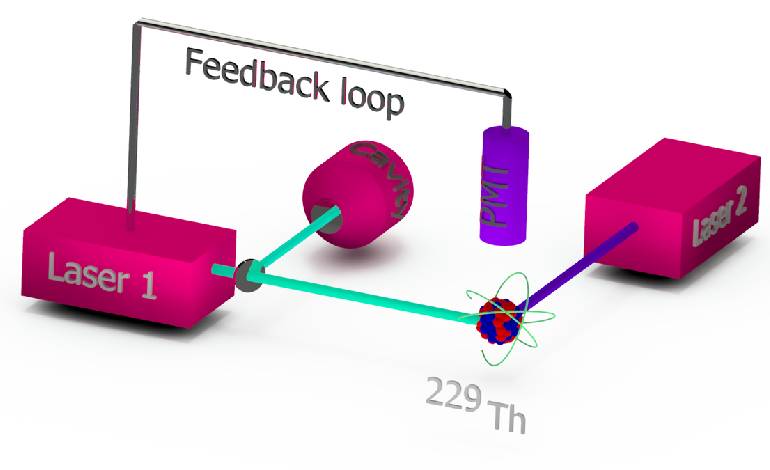
Beijing: Scientific teams working separately in Vienna and Beijing have developed the world’s first two operating nuclear clocks, calling it a major advance in timekeeping that could offer a new tool to probe fundamental physics.
The two devices represent the next generation of atomic clocks, first created in 1949. Two papers describing the achievements were published Wednesday in the journal Nature.
They are called nuclear clocks not because they are powered by nuclear fusion or fission, but because time is calculated by monitoring how light interacts with the nucleus of an atom. Both prototypes use thorium-229 trapped in solid-state calcium fluoride crystals and are interrogated with narrow-linewidth ultraviolet lasers to drive a nuclear transition rather than an electronic one.
The European team is led by Thorsten Schumm of TU Wien and Ekkehard Peik of PTB, the German National Metrology Institute. The Chinese team is led by Shiqian Ding of Tsinghua University. physics.aps.org”The creation of a nuclear clock was something that physicists dreamt of for almost 50 years. In my team, we have been working towards this goal since 2008,” said Schumm.
“The two teams worked independently and reached operating thorium-229 nuclear clocks at the same time, using different experimental approaches. I think this is very encouraging because it shows that the concept is robust,” said Ding.
The Vienna device demonstrated a precision near 1×10⁻15 and was used to set new limits on ultralight dark-matter couplings, while the Beijing device showed lower short-term fractional instability thanks to stronger laser interrogation.
Researchers said neither prototype yet outperforms the best optical atomic clocks, which can keep time with an uncertainty of 1 second every 300 million years, but clear technical paths to better performance exist including more powerful and narrower lasers and improved host crystals.
Beyond timekeeping, nuclear clocks could become compact and robust, doing away with the ultrahigh-vacuum chambers and laser-cooling systems required by today’s most precise atomic clocks, with uses envisioned in satellite-based navigation, synchronization of data transfer, surveying and metrology.