Fishermen rescue newborn elephant calf swept away in Teesta river in Bengal

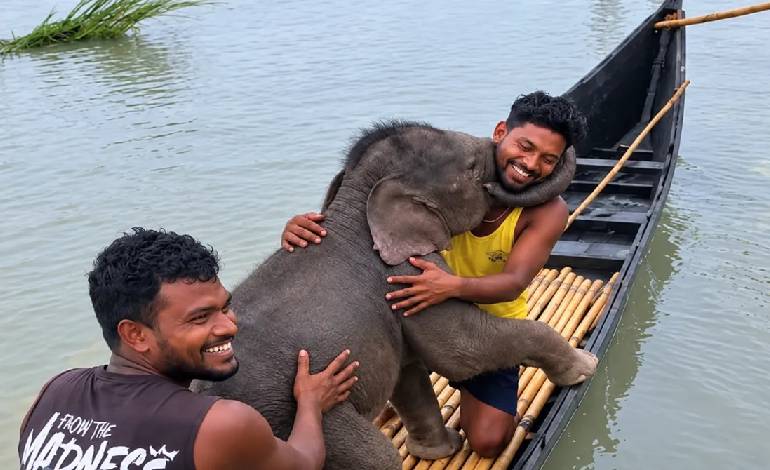
Jalpaiguri: Near Spur Number 12 in Malbazar subdivision of Jalpaiguri district, a few fishermen noticed a tiny elephant being pulled along by the river’s current. Barely a few days old, it had already been separated from its herd.
The fishermen were out on the Teesta when they saw the calf struggling in the water. They turned their boat towards it and followed it through the current for nearly three kilometres before they could reach it.
By then, the calf had travelled several kilometres from where its herd had attempted to cross the river. They pulled it into the boat.
In the video that followed, the exhausted calf is seen being held close by the fishermen — an image that many watching the footage described as a hug. The moment has since travelled far beyond the river and drawn praise on social media for the fishermen and forest officials who helped reunite the calf with its mother.
Veterinarian Nick Doley, who cared for the calf after its rescue, said the physical contact was normal elephant behaviour.“Elephants are highly social animals, and physical contact is a normal part of their lives, so the hug is normal. Calves remain close to members of their herd and routinely interact through touch,” Doley said.
He said there were no signs that the calf was displaying a trauma response to the rescue, and its willingness to remain in physical contact should not be interpreted as seeking human affection.
The calf was exhausted when it was brought in, which the veterinary team attributed to its prolonged movement through the water. There was a slight abrasion near its back but no major injury.“We did not apply or administer any medicine. It was a minor abrasion, so there was no treatment as such,” Doley said, adding that limited intervention was deliberate.“With a wild calf, we wanted the baby to be in the mother’s care first,” he said.
While prolonged human handling can sometimes create problems in reuniting calves with their herds, Doley said that concern did not apply here as the calf was only around three days old and the contact occurred as part of an immediate rescue.
Once assessed and found fit, including during weight assessment, the calf was reunited with its mother and soon drank milk — an encouraging sign for the veterinary team that it had returned to normal behaviour.
The forest department is continuing to monitor the calf and the herd using drones to limit further physical disturbance.