Saved on Everest, now saving soldiers in the Himalayas

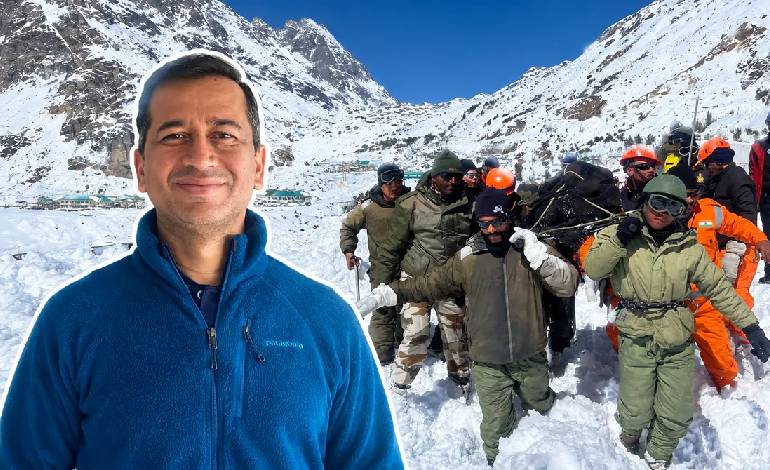
New Delhi: When a distress call comes from the Himalayas, the team has just five minutes to mobilise. Snow is deep, visibility is poor, and somewhere beneath the white expanse could be a soldier buried for hours.
This is the world of Tiranga Mountain Rescue (TMR), India’s first professional mountain and avalanche rescue organisation. Since its founding in 2016, it has deployed 16 specialised teams across avalanche-prone regions from Kashmir to Arunachal Pradesh and helped save approximately 400 soldiers.
Comprising expert mountaineers, former High Altitude Warfare School instructors, ex-servicemen and civilian rescue professionals, TMR provides round-the-clock support in extreme weather and works alongside the Indian Army and disaster response agencies.
The roots of the mission lie in a personal rescue. Founder Hemant Sachdev, an entrepreneur and mountaineer, was climbing Everest in 2013 with three friends when he fell into a crevasse in the Khumbu Icefall after a rope snapped. He was left dangling on his second rope until a friend, a professional rescuer, pulled him out. A week later, on May 19, he summited Everest.“If you don’t have a great structure or a good sense of very skilled people to provide you safety, then you can never really achieve great heights,” he recalls.
In January 2016, news of a devastating avalanche in Siachen that buried 10 soldiers — nine died, one barely survived for two days — raised a question for him.“We do it out of passion. They do it out of duty, and are still left to face these circumstances,” Sachdev says.
He met the Northern Army commander, presented a blueprint for specialised mountain rescue systems as seen abroad, and decided to build it. TMR began as a trust with just three teams and 15 people.
Today, its rescuers undergo annual training in Europe and are deployed for six months a year across the Himalayas, visiting more than 200 posts annually to assess risks, study terrain and train soldiers in avalanche awareness, mountain survival and search and rescue. TMR says it has trained over 20,000 Army personnel in the last decade.
Avalanche-related casualties in its operational regions reportedly fell from 38 in 2017 to virtually zero in 2023-24. The organisation has signed MoUs across the Northern, Eastern and Central Commands, culminating in an agreement with Army Headquarters in September 2024.
“When we receive a message, we mobilise for the mission within five minutes,” says Pradhuman Singh, who joined TMR in 2016 and runs Scape Edger Camp in Himachal’s Kinnaur. “Every rescue is challenging. The most difficult task is the evacuation.”Along with beacons, probes and shovels, TMR uses specialised tools like the RACO R9, which can detect people beneath snow via chips, beacons and mobile phones. In 2019 in Tangdhar, the team detected a mobile phone buried under four to five feet of snow.
Some missions have tested everything. In 2022, seven soldiers disappeared near Tawang in crevasse-avalanche terrain. After Army teams searched for nearly 50 hours without success, a three-member TMR team flown in from Sikkim located all seven within four hours.
In another mission in Kashmir, three soldiers were buried late in the afternoon. As Army teams prepared to call off the search due to darkness, two TMR rescuers continued and found all three within an hour — two of them alive.
Beyond avalanches, TMR has contributed to the Mount Trishul rescue, Manipur Tupul landslide in 2022, Sikkim glacial lake outburst floods in 2023, and Wayanad floods and landslides in 2024.
For Sachdev, the goal for the next decade is to expand and professionalise mountain rescue across the Himalayas.
The organisation remains privately funded, non-profit and entirely pro bono in its work for the Army.