Tiny deep-sea octopus discovered near Galápagos, first species described with CT scans alone

Nearly 1,800 meters below the Pacific surface, a remotely operated submersible filmed a tiny dark blue octopus perched on a Galápagos seamount. No human had seen it before.
Researchers have named the species Microeledone galapagensis. Small enough to fit in your palm, it’s also fully grown — a trait that may help it reproduce faster than larger relatives, biologist Janet Voight and colleagues report in the May 25 Zootaxa.
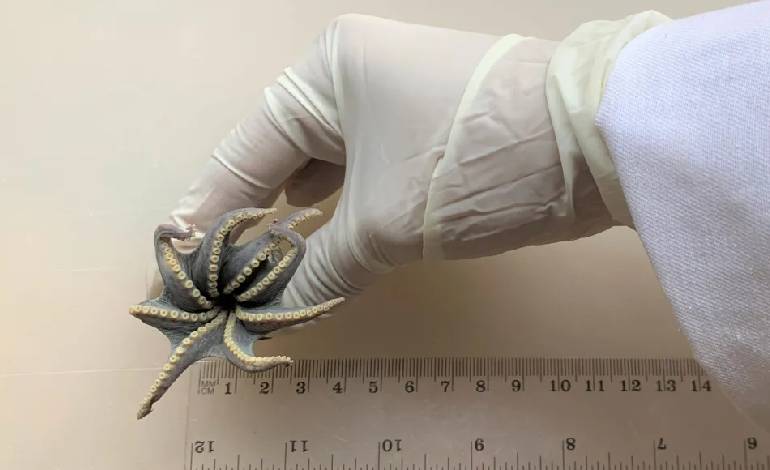
The encounter happened in 2015 during a 10-day research expedition. “It’s like those little plushies that kids put on their backpacks,” one researcher said during the dive. The team captured one specimen, roughly 10 cm long, and shipped it to the Field Museum in Chicago.
There, scientists used micro-computed tomography to build 3-D models of its organ systems. It’s the first octopus species described using CT scanning alone, without dissection. That mattered: The submersible saw four likely members of the species, but only one could be brought to the surface.
The individual isn’t a juvenile. It’s a complete adult with a full set of arm suckers and 13 eggs in its ovaries. Its small size may be an adaptation. A juvenile-sized body “could increase the rate of reproduction” by shortening the time from hatching to first eggs, says Voight, a curator at the Field Museum. Small size may also help it escape predators.
Its short, stubby arms look built for digging. That may explain its color: a pale body with dark blue arms and webbing. “When the octopus is digging in the sediment for prey, she may stimulate those prey items to bioluminescence,” Voight says. The dark webbing might shield that light from predators while it eats.
Only one other species in the genus is known, found off New Caledonia in the South Pacific. That suggests more species could live between the two areas.“The Pacific Ocean is unimaginably immense, and every part of it contains animal life from the surface to the seafloor,” Voight says. “This specimen highlights that unknown diversity.”