The retired Army officer who dug up Bengaluru’s lost rivers to stop the floods

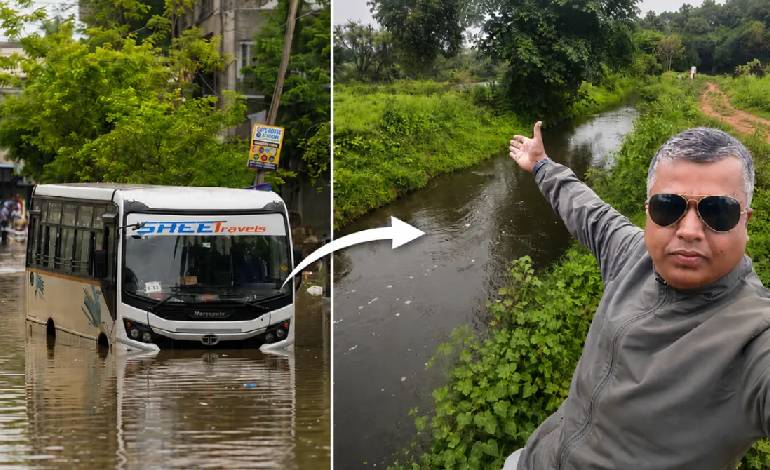
Bengaluru: Every monsoon, Bengaluru faces the same problem. Roads turn into rivers, cars stall in waterlogged streets, and homes flood after just a few hours of rain. Yet in the same city, many lakes remain dry.
For retired Army officer Captain Santosh Kumar, the contradiction didn’t make sense. If the city was getting enough rain to flood neighborhoods, why wasn’t that water reaching the lakes?The answer lay underground, beneath roads and buildings, inside Bengaluru’s forgotten network of Raja Kaluves. These ancient channels, built more than 500 years ago during Kempe Gowda’s time, once carried rainwater from one lake to another. They slowed floods, recharged groundwater, and kept the city’s lakes full.
As Bengaluru expanded, most of these channels were encroached upon, built over, or buried in concrete. Between 2017 and 2019, Captain Santosh documented lakes and stormwater drains across Anekal Taluk. He also found illegal water extraction from lakes for tanker supply. But the bigger issue was broken links — the channels that fed the lakes were gone.
Using British-era maps from 1923, he began tracing the old waterways. He walked through villages, compared the maps with the current landscape, and identified blocked stretches. Near Muthanallur and Bidaraguppe lakes, he found four historic Raja Kaluves. One had been completely encroached.
With local residents and approvals from the Minor Irrigation Department and the Deputy Commissioner, he restored nearly four kilometers of that channel and reconnected it to Battalakere Lake.
The next monsoon became the test. While neighboring areas flooded again, Muthanallur stayed dry. The revived Raja Kaluve carried rainwater along its original path, directing it into lakes instead of roads and homes.
Encouraged by the result, Captain Santosh expanded the work across Anekal Taluk and helped revive 14 ancient lakes. Several are believed to be nearly 1,000 years old.
Bengaluru today has an estimated 800 kilometers of stormwater drains, many altered by rapid urbanization. Speaking to The Indian Express in 2022, Captain Santosh said, “In natural settings, rainwater either gets soaked into the soil or makes its way to lakes and rivers. If these are maintained efficiently, we will never face floods.”
His work points to a simple truth. A city’s resilience can begin by remembering the pathways its water once knew.