Saudi solar farm doubles as safe haven for endangered Arabian sand gazelles

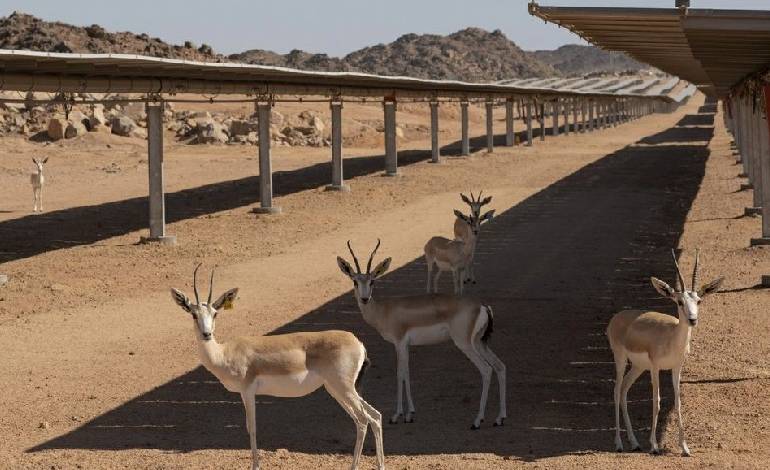
Riyadh: In a first-of-its-kind conservation effort, Saudi Arabia has turned a large solar farm into a breeding shelter for the vulnerable Arabian sand gazelle, clearing two hurdles — clean energy and wildlife protection — with one bound.
Located near the Red Sea coastline inside the Kingdom’s 24,500-square-mile nature reserve, the 250-megawatt, 1,200-acre solar plant powers the 100% renewable luxury tourist resort Amaala. It is now also home to 38 Arabian sand gazelles.
Though common in zoos worldwide, only around 3,000 sand gazelles are believed to survive in the wild across the Arabian Peninsula and Turkiye. Conservationists hope the protected solar park can help change that.
The wildlife-proof fencing around the solar panels has created a predator-free enclosure where the gazelles can feed, breed and roam safely. The shade under the panels is 8 to 18 degrees cooler than the open desert, offering crucial relief from the Arabian sun.
The initiative, launched last October with the release of sand gazelles along with mountain gazelles and Arabian hares, saw male members added in May after the animals settled in. The goal is to grow the initial group of 38 to over 500, which will then be used to re-establish a strong wild population within the larger reserve.
“Our rewilding goal is to build self-sustaining wildlife populations that can survive in the wild without ongoing human intervention,” said Andrew Zaloumis, director of the reserve.”This collaborative innovation not only accelerates that work but also introduces a novel ‘double-green’ framework with global scalability. We are calling it ‘ReWildingVoltaics.'”The concept builds on the growing global practice of dual-use solar — known as agrivoltaics — where sheep graze and crops are grown around panels.
According to the Saudi Gazette, the project supports the Saudi Green Initiative targets to protect 30% of the Kingdom’s land and sea and generate 50% of its electricity from renewable sources by 2030.