No saccades in the sky: Pigeons fix their gaze to fly straight

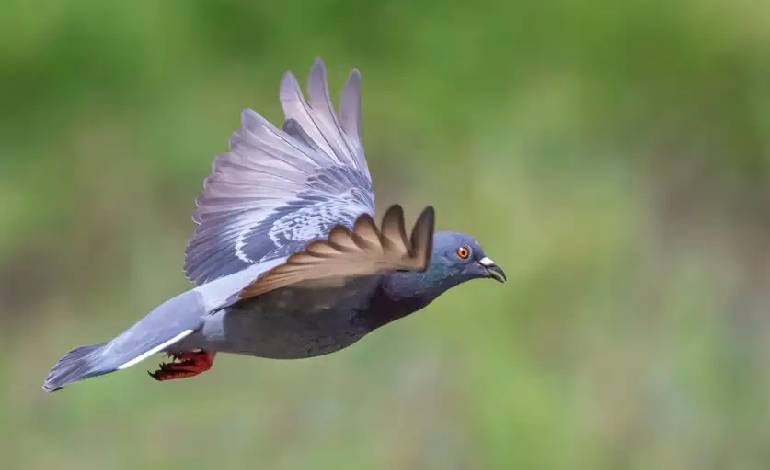
Scientists have tracked the eye movements of a bird in flight for the first time, revealing that pigeons lock their eyes in place rather than looking around. The behaviour may help them control flight, but could also leave them more vulnerable to predators.
While animals on the ground move their head or eyes and use rapid pupil movements called saccades to keep a stable view of objects, no one knew what happens when birds are flying. To find out, Ivo Ros at the California Institute of Technology and his colleagues designed a lightweight rig of mirrors and cameras attached to a pigeon’s head, plus a small backpack with a camera control board and battery.
They trained six pigeons to fly 20 metres between indoor perches and three to fly 25 metres outdoors to return to a coop. During test flights in both settings, the head-mounted system showed that after take-off, the birds increased pupil size and adopted a fixed, consistent eye position in their heads. “Whenever they start flying, the eyes rotate forward on average,” Ros said.
If their heads moved, their eyes moved in synchrony. The fixed position aligns with the primary horizontal axis of the birds’ vision and their vestibular system, which controls balance and spatial orientation. Pigeons can move their eyes independently up to about 15 degrees, but during flight the movements were less than 1 degree. “That does suggest the birds are actively stabilising the position of their eyes when in flight,” said Graham Martin at the University of Birmingham.
Ros thinks the alignment with the vestibular system may help pigeons distinguish their own motion from external motion like moving branches or a predator, aiding balance and navigation. Reducing eye movements may also minimise computational load on the brain, since the world moves much faster during flight.
The trade-off is visibility. Eye movements give pigeons a horizontal field of view of about 340 degrees, but locking eyes forward likely reduces this and creates a larger blind spot behind them where predators could approach. Ros said all tests were done low to the ground and wonders if eye behaviour would differ at higher altitudes or when flying in flocks. Martin believes other birds, including predatory peregrine falcons, may also stabilise eye position during flight to track prey along curved paths.