“Lightning in a Bottle” lets scientists turn natural gas into fuel with tiny plasma bolts

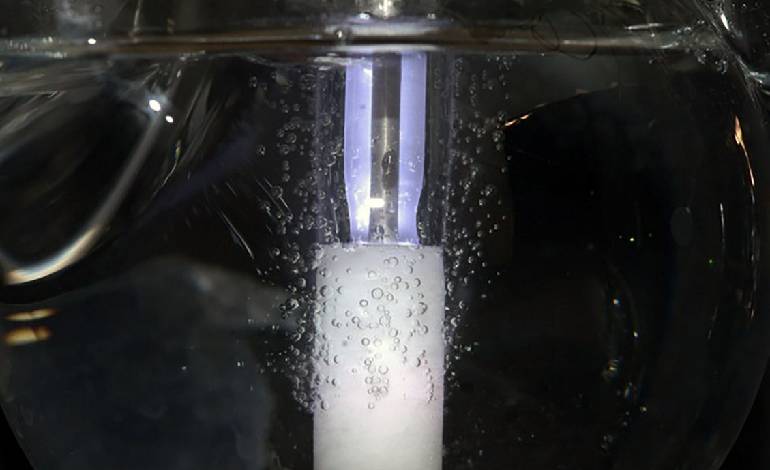
Evanston, Illinois: In a lab at Northwestern University, chemists have found a way to turn natural gas into liquid fuel using what looks like bottled lightning.
By firing tiny bursts of plasma — essentially mini lightning bolts — through glass tubes submerged in water, the team converted methane directly into methanol in a single step. Methanol is a high-demand chemical used in everyday products, as an industrial solvent, and increasingly as a cleaner-burning fuel for ships and boilers.
Current industry methods blast methane apart with extreme heat and pressure, then rebuild it as methanol over several steps. The process works, but it’s energy intensive and pumps out millions of tons of carbon dioxide each year.
“The extreme temperatures are needed to break the unreactive chemical bonds between carbon and hydrogen in methane,” said Dayne Swearer, the study’s corresponding author. “Then, you must use high pressure to squeeze all those molecules together onto the catalyst in order to make the methanol molecule. It works, but it’s not the most straightforward path to making methanol from methane.”
The new method skips the heat and pressure. It uses just electricity, water, and a copper-oxide catalyst. Plasma generated in the glass tubes activates the methane, letting it react with water to form methanol directly.
For Swearer and his team, the appeal isn’t just cleaner chemistry — it’s making something complex feel simple. “We’re taking a molecule most people burn in their stoves and turning it into a liquid fuel with a spark,” he said. The work was published in the Journal of the American Chemical Society.
If scaled, the electrified approach could cut emissions from one of the world’s most widely used chemical building blocks, while giving industries a more direct path from gas to liquid fuel — all started by a flicker of plasma in water.