India’s first fusion power company takes key steps, eyes tokamak design by 2027

Bengaluru: If all goes to plan, India may see designs for the first privately built tokamak — a nuclear reactor that uses fusion to produce energy — firmed up in 2027.
Bengaluru-based startup Pranos Fusion, India’s first private fusion power company, has built PRAGYA, a small doughnut-shaped tokamak, to test plasma control and high-temperature superconducting (HTS) magnets. This is a gateway to building PRANIK, a much larger tokamak that will have plasma heated up to millions of degrees — more than the interior of the Sun — necessary to fuse hydrogen atoms and create energy.
“By 2027, we expect to finalise the blueprint for PRANIK and be on our way to building a practical reactor that can produce energy. To be able to actually produce electricity from fusion is a further step away,” Shaurya Kaushal, co-founder and CEO of Pranos Fusion, said.
The company is currently incubated at the Institute of Plasma Research (IPR), a body under the Department of Atomic Energy, and the Jawaharlal Nehru Centre for Advanced Scientific Research (JNCASR), Bengaluru, under the Department of Science and Technology.
Pranos Fusion was one of the deep-tech startups showcased at the Emerging Science, Technology and Innovation (ESTI) Conclave held last week.
Founded in 2024 by Kaushal, a Ph.D from JNCASR and BITS Pilani graduate, and Roshan George, a Computer Science engineer from Manipal Institute of Technology, the company says compact machines, HTS magnets and India’s manufacturing base can bring costs down substantially.
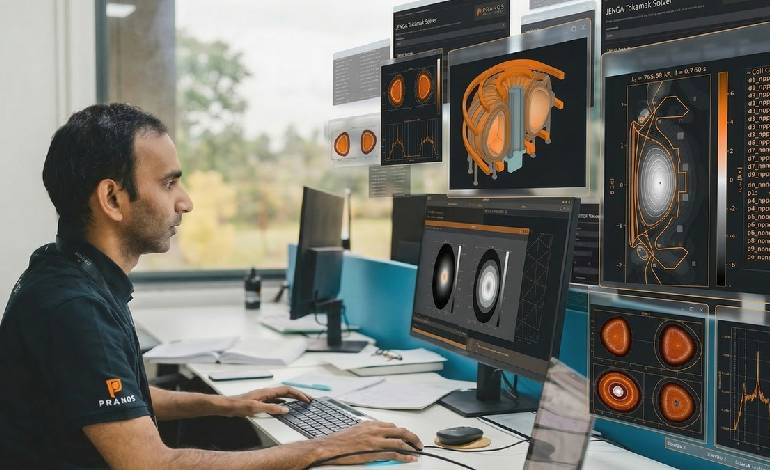
The startup has raised $7.2 million from investors including Ankur Capital, pi Ventures and Industrial47. The company has structured its technology to generate value before a power plant exists. It has two platforms — JENGA, a simulation, design and control software that works as a digital twin of the machine, and MAGGA, its HTS magnet development platform.
Globally, fusion is seen as a holy grail of clean energy, but commercialisation remains years away. India is already a member of the ITER project in France and operates the SST-1 tokamak at IPR. The entry of private players like Pranos and Hyderabad-based Anubal marks a new chapter after the SHANTI Act, which received presidential assent in December 2025, opened licensed nuclear facilities to private participation.