Zurich: Cement production, one of the world’s largest industrial sources of CO2, could one day help remove greenhouse gases from the atmosphere instead of adding to them, according to a new study by researchers at ETH Zurich.
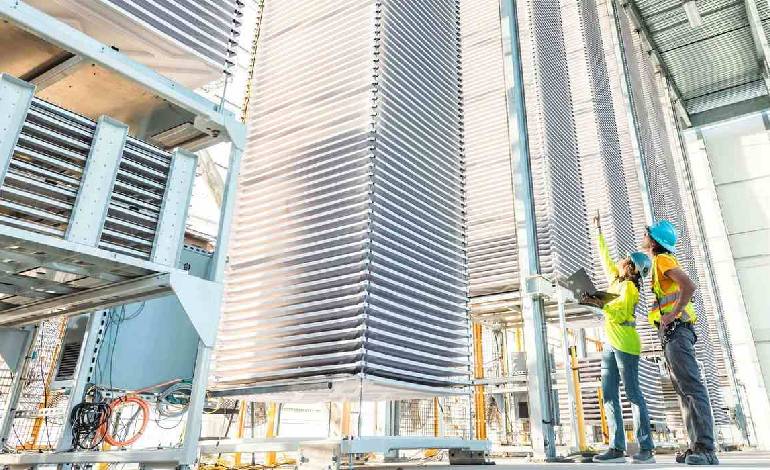
The study, conducted with US company Heirloom Carbon Technologies, shows that combining cement manufacturing with Direct Air Capture (DAC) using “calcium looping” could cancel out a large share of the industry’s emissions.
Cement production emits around 4 billion metric tons of CO2 per year, mainly during the heating of limestone, or calcination, to produce quicklime.
The ETH Zurich team, led by PhD student Vittoria Bolognaro, found that 78% of a cement kiln’s carbon emissions could be eliminated if the kiln ran on electricity instead of fossil fuels. In calcium looping, the same process used for cement is also used to capture CO2 from air. Limestone is heated to release CO2 and quicklime.
When water is added, the slaked lime absorbs more CO2 from the atmosphere and turns back into limestone, which can be reused to make cement. The CO2 captured from the air is not stored in the cement. Instead, it is compressed and sent to underground storage sites. The more cycles the calcium undergoes, the more CO2 the plant removes.“From a climate perspective, the combination of DAC and cement production is very promising,” Bolognaro said. “Heirloom was an ideal partner for us because the company is already operating the first calcium looping DAC systems on a commercial scale.”Heirloom has been running a plant in California since 2023 with a capacity of 1,000 tons of CO2 per year. The ETH study is the first prospective life-cycle analysis of calcium looping DAC at industrial scale.
The researchers tested different energy scenarios: using the current US electricity mix, a decarbonized mix of wind and solar, and a fully autonomous system with solar and batteries. Their results showed the technology has a net-negative carbon footprint. Depending on the energy mix, the efficiency of CO2 removal could reach between 85% and 96% by 2050.
However, the study notes several caveats. The projections assume major progress in decarbonizing electricity by 2050. Key components like electric calcining kilns are also not yet in large-scale use, and no detailed cost analysis was done.“The largest share of the environmental footprint is attributable to the energy required for the process,” the researchers noted, adding that water and land use impacts were also assessed.
The team says the findings provide an important starting point to explore how cement plants could shift from being major emitters to carbon removal hubs.