Brainy bees: Bumblebees use balls as ladders to solve puzzles without training

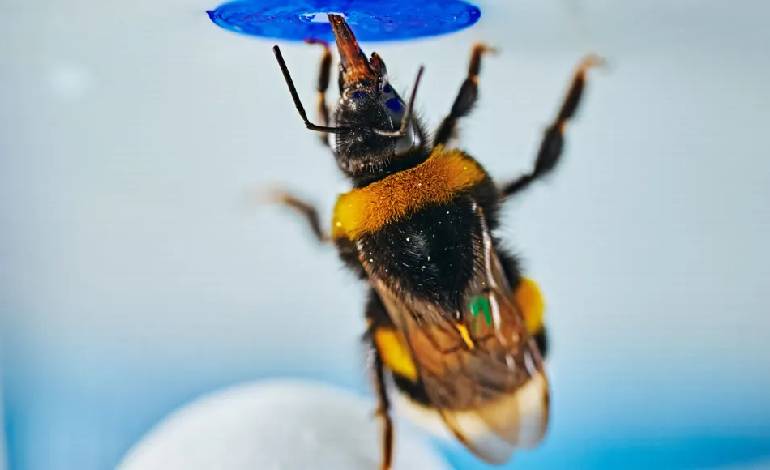
Bumblebees can figure out solutions without training. It’s the first time spontaneous problem-solving has been shown in an invertebrate.
Researchers from the University of Oulu, University of Helsinki, and University of Turku report in the June 4 Science that buff-tailed bumblebees Bombus terrestris solved a novel object-manipulation task on their own.
The test was simple but tough. Bees first learned two things: balls are moveable objects, and a blue ring means food. Then they were put in a plexiglass arena with a fake blue “flower” containing sugar water stuck to the ceiling. The ceiling was only 3.2 cm high — too low to fly or stand up to reach. A plastic foam ball sat on the floor.
More than 70% of the bees figured it out. They rolled the ball under the flower, climbed on top, and used it as a makeshift stepladder to reach the reward. None had been trained on that solution.
To rule out luck, researchers added a second room that hid the flower. Bees still solved it, showing they were working toward a goal, not just stumbling around. Even when the flower wasn’t visible from the ball’s starting position, they succeeded. Lead author Akshaye Bhambore said the bees showed “spontaneous, goal-directed problem-solving” without trial-and-error or copying others.
“Spontaneous problem-solving is something that has never been shown in any invertebrate before,” said Olli Loukola, behavioral ecologist at the University of Oulu. Until now, that skill was only confirmed in vertebrates like chimpanzees, parrots, elephants and some birds.
The finding challenges the old assumption that big brains are needed for insight. With a brain the size of a sesame seed, the bees still had “aha moments” when they hit the solution.
Loukola notes this doesn’t mean bees have human-like reasoning or consciousness. But it does expand what we know about invertebrate intelligence. Bumblebees already show emotion, social learning, and even teach each other to “play soccer” for rewards.