Bacterial enzyme comes close to challenging biology’s central dogma, studies find

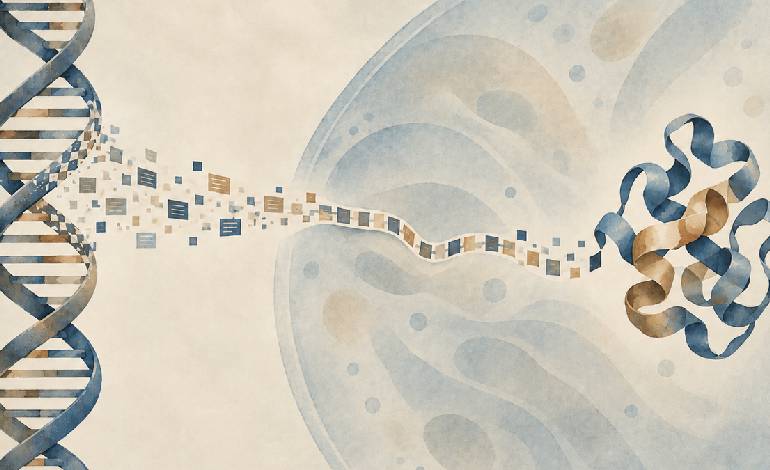
New Delhi: For 69 years, biology’s central dogma – that genetic information flows from DNA to RNA to protein, and never in reverse from protein – has remained unchallenged.
Two new papers published in the journals Cell and Science have now reported a discovery that comes closer than ever to testing that rule.
Researchers have found a new family of bacterial reverse transcriptases that can synthesize a DNA molecule without any template.
Usually, reverse transcriptases use an RNA molecule as a template and make a DNA copy of it. This was first discovered in 1970 by US biologists Howard Temin and David Baltimore in retroviruses, which used RNA as genetic material to make DNA. The discovery had then sparked debate about whether the central dogma had been violated.
Francis Crick, who had proposed the central dogma in 1958, had clarified that a true violation would require information flowing from proteins to proteins, or from proteins back to DNA or RNA. For information to flow from RNA to DNA was still within nucleic acids, he argued.
The new studies have found something more unusual. According to the reports, these specific bacterial reverse transcriptases – identified as part of a system called Drt3 – do not use any RNA template at all. Instead, the enzyme itself provides the information needed to determine the sequence of the DNA it generates.
One protein in the system, Drt3a, builds one strand using a template in the familiar way. The other, Drt3b, builds the complementary strand without a template. Specific amino acids in the protein – Glu26, Arg253, Thr335 and Thr338 – act as a guide, locking onto DNA building blocks one by one.
It is the first known protein to produce a long, sequence-specific strand of DNA using nothing but its own structure as a guide. Other proteins have done something similar before, but only in short fragments.
The finding has sparked fresh debate.Some scientists say it does not yet break the central dogma. The information for the alternating pattern that Drt3b produces is already encoded in the gene that builds Drt3b itself. So what looks like protein-to-DNA is actually DNA-to-protein-to-DNA – a loop, not a violation. The protein is executing a pre-set pattern, not creating new information.
Others say the mechanism is still groundbreaking. Scientists have been studying DNA since the 1950s and bacteria have been quietly doing something never imagined possible, raising the question of what else is being missed.Researchers also see a practical angle. If Drt3b can be engineered to produce other DNA sequences, it could one day work as a tool for building custom DNA molecules without needing a template to copy from.”We do not yet know if it can be reprogrammed or engineered in a useful way,” Rafael Pinilla-Redondo, assistant professor at the University of Copenhagen, was quoted as saying.