American Prairie bison herd tops 1,000 for first time in conservation project’s 20-year history

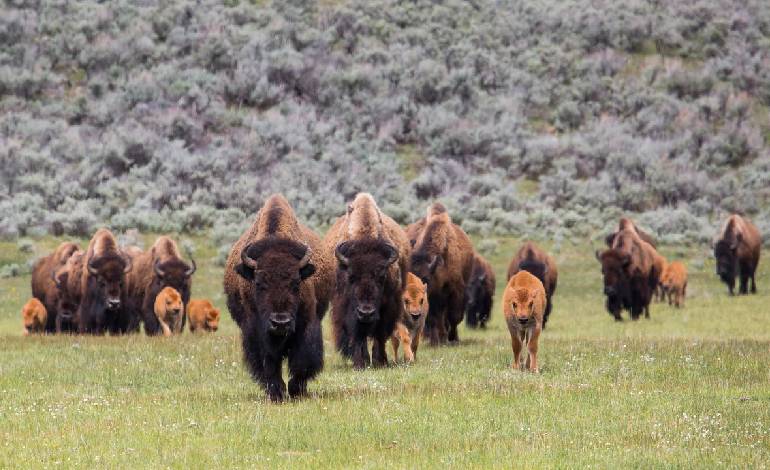
Montana: As autumn settles over the Great Plains, the largest private land conservation project in the United States is celebrating a historic milestone – its herd of free-roaming bison has reached four digits for the first time.
American Prairie, the nonprofit working to stitch together the largest contiguously wild stretch of prairie in North America, announced that its annual calf count at the end of breeding season put the herd at 1,016 bison.
The reserve, located primarily in northeastern Montana, now spans 603,657 acres – including 167,070 deeded acres and 436,587 leased public acres. If declared a National Park, it would rank among the 10 largest in the Lower 48. Its ultimate goal is to protect and rewild 3.2 million acres.
The milestone comes at a critical time for bison restoration. Though tens of millions of bison once roamed the plains, today their numbers are just 1 to 3.5% of pre-industrial levels. And of those that remain, less than 10% are managed for conservation as a wild species.
Most conservation herds, American Prairie notes, are small and confined to fenced areas – conditions that threaten genetic health and prevent bison from displaying natural behaviors and delivering their vital ecological impact on the prairie landscape.
Legal hurdles remain one of the biggest obstacles. In Montana, bison are still classified as livestock, not wildlife, meaning their movements and grazing are regulated like cattle to prevent cross-breeding, disease spread and encroachment.
That classification led to a recent court battle. In May 2026, the Bureau of Land Management (BLM) revoked American Prairie’s bison grazing permits and ordered the nonprofit to remove its bison from three federal grazing allotments that make up much of the reserve. The BLM argued that federal grazing law provides land solely for commercial production of food and fiber.
American Prairie challenged the order, and on September 4th, a federal judge granted a preliminary injunction blocking the BLM from enforcing it. The judge found American Prairie’s interpretation – that the Taylor Grazing Act includes no such commercial-only distinction and allows for conservation and recreation – was highly likely to be correct.
Fresh off that legal victory, the count of 1,016 marks a turning point. Organizers say a herd of 5,000 is an achievable near-term goal, but the long-term vision is far bigger. The 5,000 square miles they hope to ultimately protect could theoretically support tens of thousands of bison, restoring a piece of the vast, thundering herds that once defined the American West.