Nagaland communities lead revival of Asia’s largest tortoise

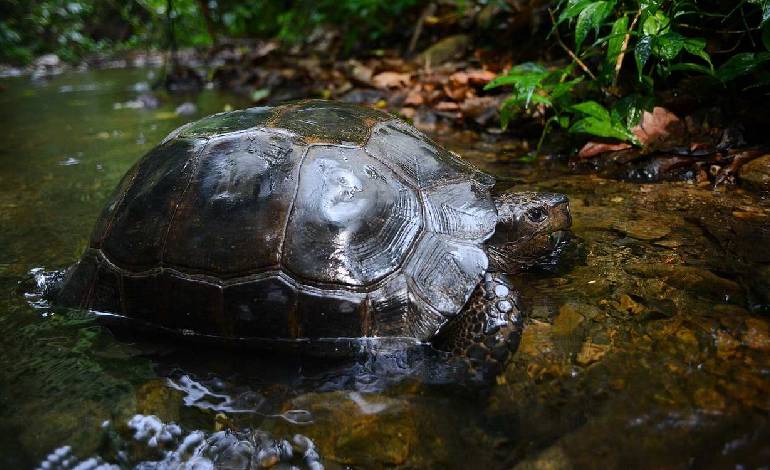
Kohima, Nagaland: In India’s far-eastern state of Nagaland, locals who once hunted the Asian giant tortoise are now spearheading efforts to save mainland Asia’s largest tortoise species from extinction.
The Critically Endangered tortoise was nearing population collapse until the Nagaland Zoological Park launched a captive breeding program. The program began with 13 animals — some seized from markets where they were to be sold for meat, others kept as pets.
“The program reached its turning point when some villagers voluntarily donated tortoises they had kept as pets in their homes for captive breeding, and the community that once exploited them was sensitized to restore and nurture the species back in the wild from the brink,” said Shailendra Singh, Director of the Turtle Survival Alliance Foundation India, which oversees reintroduction with the Nagaland Forest Department.
From the original 7 females and 6 males, 114 tortoises have now been born — about half the estimated wild population across Asia. Earlier federal reintroduction efforts failed to protect or track the animals. The new approach relies on Nagaland’s tribal reserves instead of government reserves.
Over 100 tortoises have been released into these small, numerous community-managed areas. Local youths, trained in basic conservation strategies, now serve as the tortoises’ “guardians.” The close, often one-to-one involvement has fostered a unique attachment to the species among residents.