April skies set to dazzle with lyrid meteor shower and milky way views

With April opening on a full Moon, the month now lines up several celestial events that give stargazers a reason to head out into the shortening spring nights.
Chief among them is the Lyrid meteor shower, which peaks on the night of April 22 into 23. This year, the Moon will set before midnight, leaving dark skies for viewing. From a site far from city lights, observers can expect up to 15 shooting stars per hour.
The Lyrids are not stars but fragments of comet C/1861 G1 Thatcher. Each year, Earth passes through the comet’s debris trail, and the ice and dust burn up in the atmosphere as bright streaks. The Lyrids are one of the most active spring showers.
They take their name from the constellation Lyra, the point in the sky from which the meteors appear to radiate. To find Lyra, look for Vega, the second-brightest star in the Northern Hemisphere. Vega is so bright it became the first star ever photographed, captured on a daguerreotype plate in 1850.
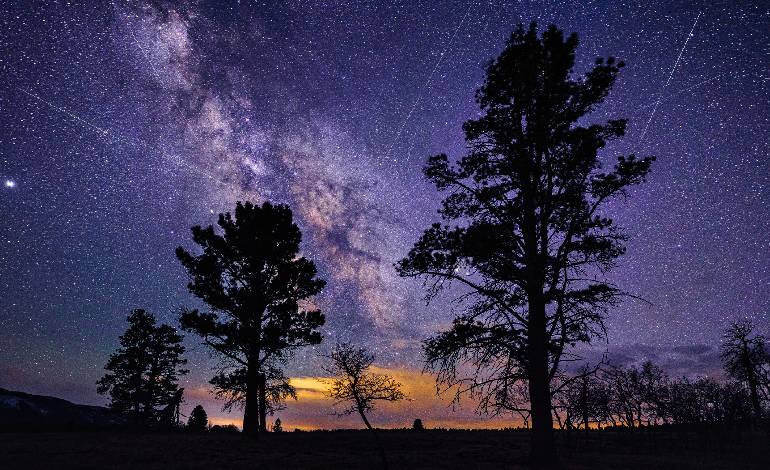
Before the Lyrids peak, a New Moon on April 17 will create ideal conditions for another sight: the Milky Way’s galactic core. Visible in the pre-dawn hours this month, the core appears as a broad band of white and grey across the sky.
Seeing it requires a truly dark sky, free from both moonlight and significant light pollution. For those who make the drive to a rural area, the reward is a view of millions of stars and the structure of our galaxy.