At 16, Bengal student builds system to predict crop burning before it happens

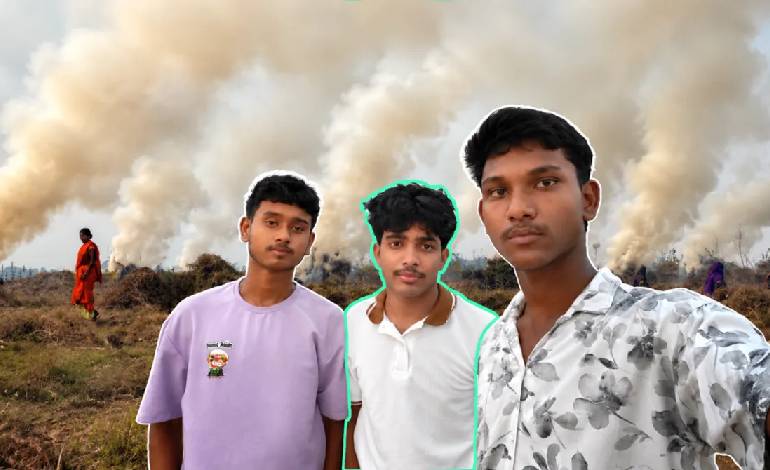
At first, 16-year-old Sk Reezaal Arafat thought someone near his home in Medinipur, West Bengal, was burning rubbish. For the past two winters, he had been noticing tiny particles of ash floating in the air.
He had grown up hearing about Delhi’s ‘gas chamber’ winters and the smoke caused by stubble burning in Punjab and Haryana. But he had never expected to find the same problem close to home.
When he began looking into where the ash was coming from, he discovered that farmers in his own district were setting fire to stalks left behind after harvesting.
It bothered him. Why were farmers still burning waste when the smoke was affecting people nearby? What would it take to stop it?The first thing he learnt was cost. Clearing just one bigha of farmland by hand could cost around Rs 600, while burning cost almost nothing. With another crop to plant and little time, burning was the easiest way out. Machines had made harvesting faster, but many farmers still didn’t have equipment to clear waste.
But Reezaal noticed another problem. By the time someone spotted a fire and authorities responded, the damage was done.
That question led to SATARK, a climate-tech initiative he started in December 2025. He now leads a team of mostly 15 to 18-year-old student volunteers, with over 30 ‘Student Guardians’ connecting the initiative with farmers. He built it while in school, juggling field visits and coding alongside board exam preparation.
SATARK aims to identify where crop waste is likely to be burned and help authorities reach farmers with alternatives before they set fields on fire.
The system has two main parts. The first is a network of low-cost IoT devices called ‘sentry nodes’ that collect local weather data including wind direction, air pressure and moisture. The second is a prediction model called ‘smart burning windows’ that uses satellite images, crop data and weather to identify fields nearing harvest and assess burning risk.
It uses NDVI, a way of measuring how green crops are. By tracking fields as they change from green to harvest-ready brown, SATARK can identify places where farmers may soon need to clear waste. The sentry nodes then estimate where smoke would travel if a fire starts.
“At first, we were only looking for who was burning,” Reezaal says. “But we should also look for the people who are not burning — the positive deviants.”
That shift, guided by mentors including Dr Daniel Aldrich, Dr Ruth DeFries of Columbia University, Dr Adway Mitra of IIT Kharagpur, Dr BK Mohan of IIT Bombay and Dr Arun PV of IIIT Sri City, helped the team understand local practices already reducing dependence on fire.
By June 2026, SATARK had directly worked with 37 farming families across eight villages. Its base includes five schools: Siddha Sashi Sripati Vidyabhaban, Harasankar Garkilla High School, Raghunathbari High School, Uttar Jianda High School and Gopalnagar B.L. Vidyapith.
The initiative has received pilot backing from local officials including the Block Development Officer in Kolaghat, created a 34-farmer socio-economic dataset published on Harvard Dataverse, and received OSHWA open-source hardware certification.
On the ground, the team says work begins with trust, not tech.”We don’t start with questions,” says field team member Sanket Kuila. “A lot of farmers are tired of outsiders showing up, asking things, and then disappearing. So we sit with them first.”Instead of lecturing about pollution, the team offers soil reports, fertiliser guidance and evidence on how burning affects topsoil. In one comparison, a farmer who had repeatedly burned residue had lower soil organic matter and lower yield than those who hadn’t.
The team has also documented nine ways farmers are already managing paddy straw without burning — from feeding cattle to mixing it back into soil.”The satellite and the sensors are the easy part,” Reezaal says. “The hard part is making sure that when a farmer decides not to burn, there’s actually something waiting for them on the other end.”