Antarctica’s Ross Island wind turbines prove renewables can survive the harshest conditions

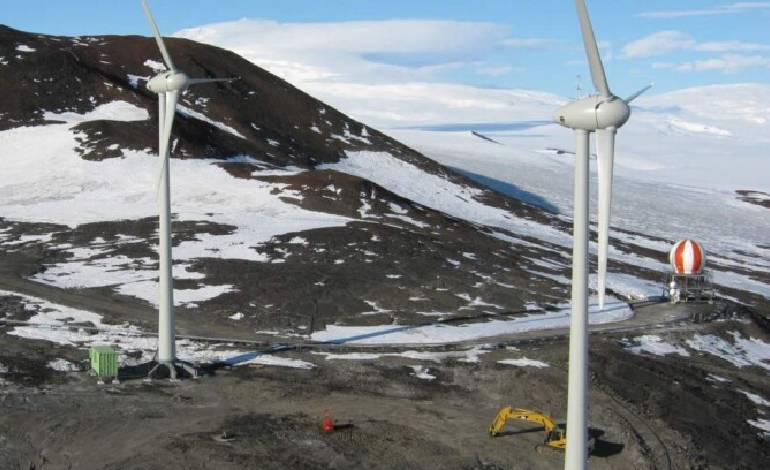
Ross Island: As they near the end of their productive lives, the three wind turbines spinning on Antarctica’s Ross Island have made an enormous impact on the energy use of the continent.
Built and commissioned over 2008-2009, the Ross Island Wind Farm was a daunting engineering challenge that has mitigated roughly 122,000 gallons of diesel fuel consumption, and the associated costs of shipping fuel to the pole.
Powering America’s McMurdo Station and New Zealand’s Scott Base, the farm has proved that renewable installations can survive in even the harshest environment.
The farm was built by New Zealand firm Meridian Energy. Diesel generation had long been the only source of energy for the two bases, with fuel shipping costs drawing heavily on research funding.
The long Antarctic winter required a novel design. Each turbine was bolted onto Ross Island’s Crater Hill like a spider, with legs drilled into precast concrete blocks set into “Antarctic cement” — a mixture of water and gravel that freezes solid in perpetuity.
Built to resist fearsome winds and -30°C temperatures, the turbines spin without transmissions, eliminating problems with oil viscosity and reducing moving parts. Components had to be small enough to fit in shipping containers, as vessels only reach Ross Island at the end of Antarctic summer.
Despite the challenges, the purpose-built Enercon E33 turbines, each delivering 330 kilowatts, have survived 15 years of service. When wind is weak, diesel generation makes up the difference.
The turbines will be replaced with larger, more powerful models with a battery storage system when they reach the end of their lives in 2030 as part of a power-sharing agreement between the US and New Zealand. During the 2024/25 season, the construction team completed the first foundation for one of the new turbines.
For scientists at Scott and McMurdo, the wind farm has substantially reduced operating costs and carbon emissions. An estimated 1,200 tons of CO2 have been prevented.