China claims world first in cleaner hydrogen-boron nuclear fusion

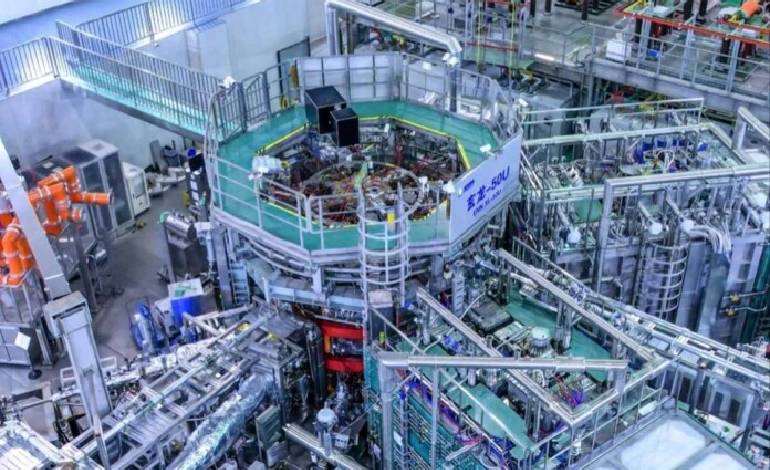
Beijing: In a world first, Chinese engineers have achieved brief nuclear fusion using a cleaner and more abundant fuel supply, in what an international review team has called a “significant and valuable” advance.
Using hydrogen-boron as fuel, state-backed energy firm ENN Group used a laser and radio waves to generate plasma within a spherical reactor device known as a tokamak.
Nuclear fusion, which replicates the process of fusing two atomic nuclei at the centre of the Sun, could generate vast amounts of energy with no emissions and no radioactive waste, unlike nuclear fission. The standard fuel proposed for commercial fusion, a mixture of deuterium and tritium, is extremely expensive and produces radiation. While deuterium is available from seawater, tritium is scarce, radioactive and cannot be mined naturally.
ENN has opted for the hydrogen-boron route. Inside the tokamak chamber, one hydrogen proton fuses with a boron-11 nucleus to produce harmless helium nuclei and energy, without releasing high-energy neutrons.
According to World Nuclear News, private firms like TAE Technologies in the US and Marvel Fusion in Germany are also experimenting with hydrogen-boron fuel.
ENN’s method of generating plasma was also novel. Instead of relying solely on intense magnetic fields from superconducting magnets to heat fuel to hundreds of millions of degrees, the team used a dual approach of high-energy neutral beam injection and radio frequency waves to target the exact spot in the fuel where particles are most likely to react.
“Under this mechanism, a large number of ‘fast protons’ are rapidly generated within the system,” reports South China Morning Post. “Acting as a catalyst, these high-energy particles triggered a chain reaction, pushing the overall fusion reaction rate beyond 100 million times per second.”A delegation of visiting scientists who reviewed the experiment agreed unanimously that it was a significant contribution to the field.
Chief engineer Yang Yuanming, who led the project, shared the milestone on social media on Monday, adding that the team will now “strive to get the plasma to 100 million degrees Celsius as soon as possible.”