Indian scientists create reference genomes for four threatened Asian hornbill species

Bengaluru: Researchers from India have generated reference genomes for four threatened species of Asian hornbills, reports contributor Nikhil Sreekandan for Mongabay India.
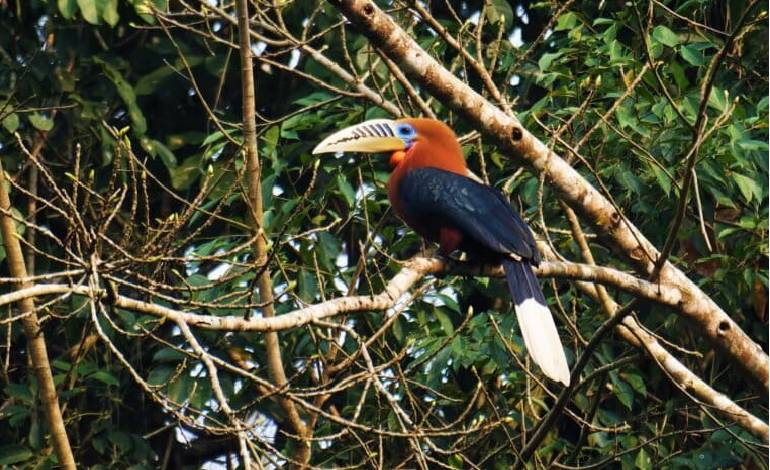
The scientists from the Nature Conservation Foundation (NCF) in Mysore and the CSIR-Centre for Cellular and Molecular Biology (CCMB) in Hyderabad assembled high-quality genomes for threatened Asian hornbill species including the great hornbill, rufous-necked hornbill, Malabar pied hornbill, and wreathed hornbill.
Prior to this study, whole-genome information was available for only two of the 32 Asian hornbill species.
The research team used two types of genetic sequencing to create genetic maps for each of the species; together short- and long-read DNA sequencing helped researchers minimize errors.”A genome is the complete genetic structure of an organism, and a reference genome is a baseline genome for a particular species,” said Pooja Pawar, corresponding author of the study and a doctoral researcher at NCF.
The team used statistical modeling to trace changes in hornbill populations over time, and discovered that climatic instability during the Pleistocene epoch reduced the effective population sizes of all four species.
Among them, the widely distributed wreathed hornbill had a higher effective population size than the other three.”Genetic variation or diversity is crucial to the adaptive potential and long-term resilience of populations,” said Meghana Natesh, a conservation geneticist at WWF India who wasn’t involved in the study.”By comparing their genomes, we can attribute differences in their characteristics to the structural and functional variations within their genomes,” Pawar said.