IIT Guwahati develops low-cost tech to remove arsenic and fluoride together

Guwahati: A glass of water can look clear and still contain contaminants that cannot be seen, tasted, or smelled. In several parts of India, groundwater contains naturally occurring arsenic and fluoride that pose serious health risks with long-term exposure.
The challenge becomes bigger when both are present in the same water. Removing one contaminant does not necessarily mean removing the other, making treatment more complicated and expensive.
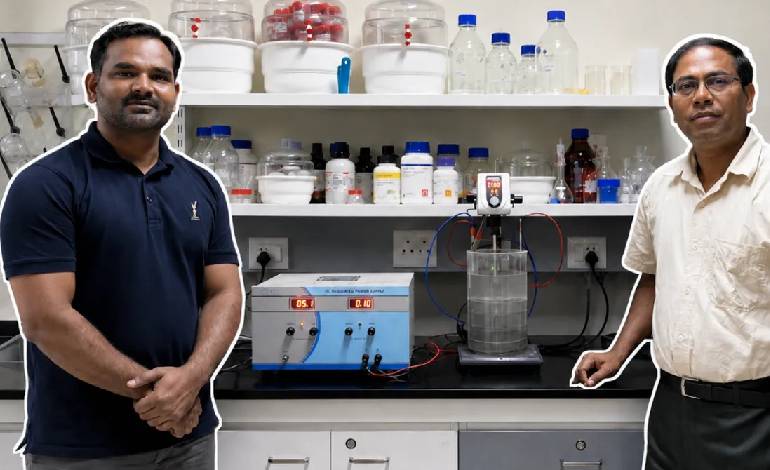
Now, researchers at IIT Guwahati have found a way to tackle both at the same time. The team has developed a rotating-anode electrocoagulation (RA-EC) reactor that can remove up to 98.2% of arsenate and 91.8% of fluoride within minutes. The initial demonstration puts the estimated operating cost at just Rs 18 to Rs 58 for every 1,000 litres of treated water.
The idea builds on a familiar process called electrocoagulation, where electricity and metal electrodes are used to pull pollutants out of water. The IIT Guwahati team made one important change — instead of keeping the aluminium electrode stationary, they made it rotate.
That simple movement changes what happens inside the reactor. As the aluminium anode rotates, it improves mixing, helps pollutants come into better contact with the treatment process and continuously renews the electrode surface.
When electricity passes through, aluminium ions and hydroxide ions combine to form aluminium hydroxide flocs — tiny particles that act like pollutant catchers. Arsenic and fluoride attach to them and are then removed through adsorption, coagulation and precipitation.
The rotating design also addresses electrode passivation, where material builds up on a stationary electrode over time and reduces effectiveness.
Groundwater is the primary drinking water source for millions across India. “Treating them together has remained particularly challenging because they behave differently during conventional purification processes and compete for removal sites,” said Prof Mihir Kumar Purkait, Department of Chemical Engineering, IIT Guwahati.
The researchers tested the reactor under realistic groundwater conditions, including naturally occurring ions such as calcium, magnesium, bicarbonate, sulphate and phosphate, as well as real samples collected from Assam.”Our technology was also tested under realistic groundwater chemistry,” said Mukesh Bharti, Research Scholar, Department of Chemical Engineering.
The findings have been published in the peer-reviewed Chemical Engineering Journal. The team now plans to develop a pilot-scale, continuous-flow version with sensors and automated controls to monitor pH, conductivity, current and rotational speed.
The researchers say the technology could be adapted for community drinking-water purification, decentralised rural water-treatment systems, industrial wastewater treatment, and could be combined with adsorption and membrane filtration.