Feather found in dinosaur dung may explain why birds survived mass extinction

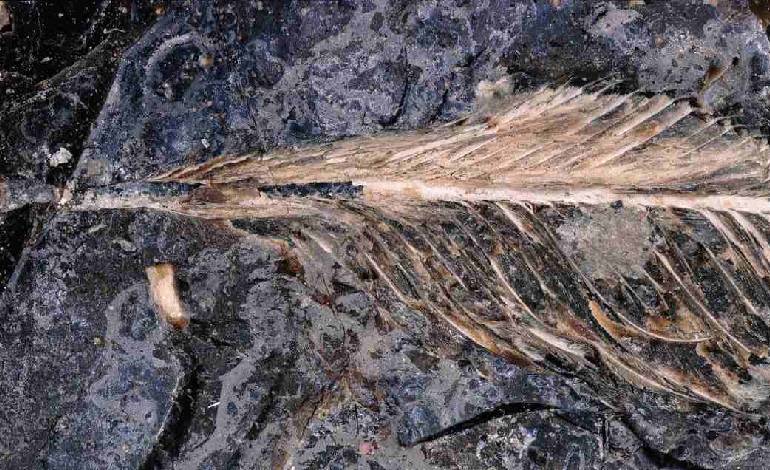
A feather preserved inside dinosaur dung could help explain why birds survived the mass extinction that wiped out most life on Earth 66 million years ago.
Scientists at the Field Museum of Chicago say a dinosaur ate a bird around 66 million years ago, and its dung preserved the best example of a feather ever found from the dinosaur age.
The fossil was discovered in 2016 by study co-author David DeMar Jr. while conducting fieldwork in Montana.”I was crawling up a rocky outcrop collecting fish fossils when I came across a dark, reddish-brown nodule about half the size of a golf ball,” he said. “I picked it up and scanned its surface through my hand lens, and that’s when I couldn’t believe what I was seeing, a tiny fossil feather.”
Scientists examined its mineral composition and took CT scans. It contained multiple feathers, tiny fish scales from a gar, and leg bones from a bird called a hesperornithiform.”Hesperornithiforms were aquatic birds, ecologically similar to loons,” said lead author Professor Jingmai O’Connor. “Most couldn’t fly, and instead, they used their specialized feet to dive down into the water to hunt for fish.”They are the earliest known avian lineage to lose flight for foot-propelled diving, but unlike Neornithes, they did not survive beyond the Cretaceous.
The feathers are the first hesperornithiform feathers ever found and represent a middle ground between primitive and modern feathers.”Some of these diving birds’ feathers seem to have been modern-looking and water-proof, but they also had some smaller, fuzzy, primitive body feathers that we associate with dinosaurs,” O’Connor said.
She believes differences in feathers may explain why only Neornithes survived the impact winter following the asteroid strike.”The hesperornithiforms retain primitive feather types that may not have been as efficient for insulation as modern plumaceous feathers, and that could explain why they went extinct,” she said.