Dogs pay more attention to consonants than vowels, just like humans, study finds

Dogs process human speech using the same strategy as humans — relying on consonants rather than vowels to break a continuous stream of sound into individual words.
According to a new study by researchers at Eötvös Loránd University (ELTE) in Budapest, published in the journal Science on September 24, 2026, companion dogs show a “consonant bias” previously thought to be uniquely human and not even observed in primates.
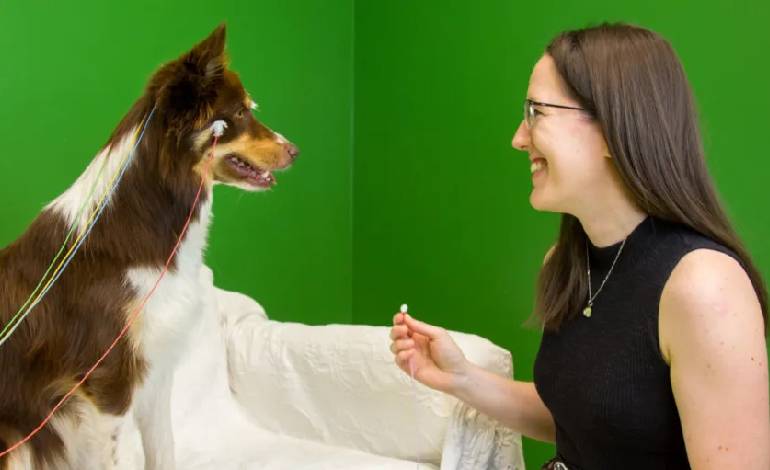
Researchers led by Boglárka Morvai and Attila Andics studied 20 dogs and 20 human adults using non-invasive EEG. Both groups listened to continuous streams of invented three-syllable words with no pauses between them.
In one version, recurring consonants defined the word patterns, in another vowels provided the structure, and a third control stream had syllables in random order with no recurring pattern.
The team measured neural synchronisation — where brain activity takes on the rhythm of sounds it detects.
They found that in dogs, the neural response to consonant-based regularities was 42% stronger than to vowel-based regularities, and 55% stronger than to the random stream. In humans, the response was nearly 25% higher for consonants than vowels and 77% higher than random.
“Dog brains segment speech into words in a way previously seen only in humans,” the researchers said.
The result is striking because vowel sounds are actually more acoustically prominent. If dogs were simply latching onto the loudest sounds, vowels should have had the advantage.
“Words are made up of two main types of speech sounds: vowels and consonants. Although vowels are louder and more noticeable, consonants usually form the skeleton of words,” said Andics.
“This is the first evidence that a consonant bias can also emerge in the brain of a species other than humans,” said co-author Kinga G. Tóth.
Researchers argue the bias in companion dogs likely comes from regular exposure to human speech reshaping their brains. “The only reason companion dogs have a consonant bias is that human speech, and specifically the characteristics of words, reshaped their brains,” Andics said.
Experts noted a practical takeaway — if you want your dog to pay attention, a name with more consonants may help.