Hundreds of ancient earthworks found in Amazon reveal lost civilization larger than thought

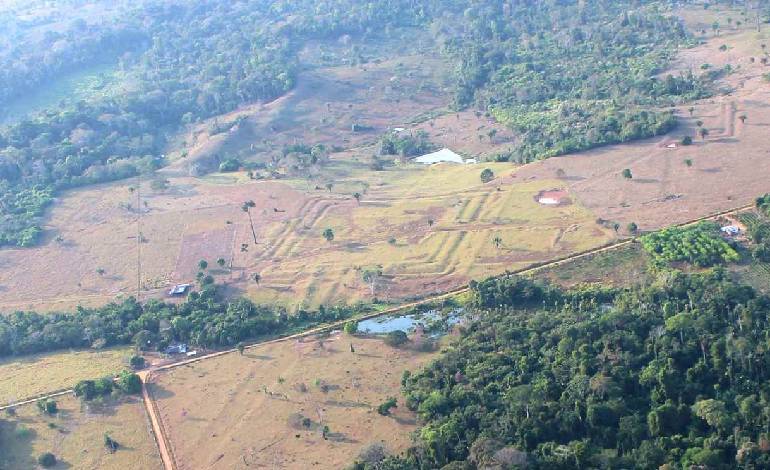
Hundreds of geometric earthworks discovered in the southwestern Amazon suggest a precolonial monument-building civilization was far larger than previously believed.
An aerial survey using laser radar dramatically increased the footprint of the Aquiry civilization. Researchers found that just 3% of the Amazon contains a greater concentration of these structures than the other 97%.
The study, published last week in Nature, was led by Martti Pärssinen at the Ibero-American Institute of Finland with colleagues from Brazil and Finland. The team surveyed 4,497 sq km using LiDAR — Light Detection and Ranging — technology that fires lasers through the jungle canopy to map the ground below.
The survey identified 432 earthworks, 396 of them previously undocumented, near Rio Branco, Lábrea, Boca do Acre and Carauari. Extrapolating from these results and satellite data, the authors estimate the region may contain 24,000 to 30,000 earthworks.
The builders, known as the Aquiry civilization, are known for large geometric ditched enclosures called Amazonian geoglyphs, believed to have served as ceremonial and public gathering centers. The structures range from 0.35 to 14 hectares, with the largest covering nearly 123 acres. Construction began around 2,500 years ago and continued until the 13th century.
The civilization peaked between the 1st and 4th centuries CE. While earlier estimates put its population at 60,000 based on 200 known earthworks, the new data suggests 1.25 to 3 million people lived in the area between 100-300 CE — putting it on par with Late Preclassical Maya societies.
“By using airborne LiDAR technology, it has been possible to triple the area of the Aquiry civilization from the earlier 60,000 sq km to approximately 183,000 sq km,” the authors wrote.