World’s most powerful solar telescope spots “Whirlpools” on sun for first time

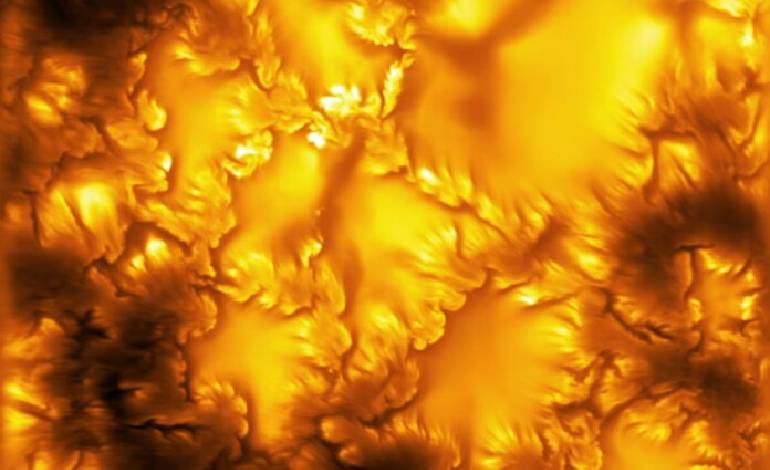
Maui: Scientists using Earth’s most powerful solar telescope have captured the first direct evidence of whirlpool-like structures on the Sun’s surface, a discovery that could help explain how the star generates and releases magnetic energy.
The Daniel K. Inouye Solar Telescope, located atop Haleakalā volcano on Maui, recorded the phenomenon known as Kelvin-Helmholtz Instability. It’s the same physics that causes ocean waves to break and whirlpools to form on Earth, and swirling patterns in Jupiter’s clouds.
Published in the journal Nature, the research shows that plasma on the Sun’s photosphere is subject to the same forces. “The vortex formation on the Sun has long been a central question in solar physics. For the first time, we have identified both their origin and their driving mechanism,” said lead author Dr. David Kuridze, assistant astronomer at the National Solar Observatory in Boulder, Colorado.
Kelvin-Helmholtz Instability occurs when two fluids moving at different speeds and directions pass each other, creating perturbations that form vortices. While theoretical models predicted it could exist in the Sun’s photosphere, “seeing these structures widespread across the surface was still a huge surprise,” Kuridze said.
The team pointed the Inouye Telescope at a magnetically-active area next to a large sunspot. They found the vortices act like “small engines” that drive magnetism, energy, and heat upward from the surface to the Sun’s outer atmosphere — a process that may help explain why the corona is hotter than the surface.
The swirling plasma can also intertwine lines of the Sun’s magnetic field through a process called flux braiding. When those field lines snap and reform, they generate intense heat.
Researchers say the discovery has far-reaching implications for understanding solar flares and coronal mass ejections. When directed at Earth, these events can disrupt satellites and power grids, trigger auroras, and damage electrical equipment.
Solar physicists believe these small solar whirlpools may be more important precursors to large eruptions than other signals. The ultimate goal, scientists say, is to use the formation and movement of the vortices to forecast future solar storms that could impact Earth.