From tree-cutter to tree-planter: Puducherry man grows mangrove forest on his own

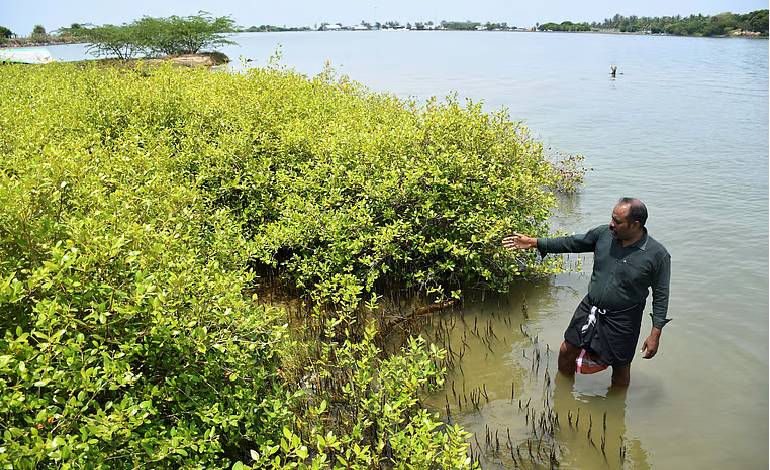
Nestled where the Chunnambar River meets the Bay of Bengal, a thriving man-made mangrove swamp now guards the coast of Pudukuppam village. The force behind it is 49-year-old R Raja, who planted the trees five years ago and still funds their upkeep himself.
Raja lives 10 kilometres away in Thengaithittu and has been growing mangroves in backwaters around Puducherry for over a decade. Pointing to the island-like green stretch near Paradise Beach, he says, “It is not a cakewalk. It needs hard work, patience and money.”
Forced to leave school after Class 6, Raja began as a tree-cutter to earn a living. He later moved through several jobs and now works in what he calls real estate with a twist: “I buy land, create small forests, and sell them to people who want to live close to nature. I also help others develop forests on their lands.”
Local fisherman E Maheshwaran ferries Raja by boat for maintenance, since fences block land access. “Since planting them, I have relied on local fishermen to take me to the area. It has now started looking like a small mangrove forest.”
Raja’s mission began decades ago when the civic body cut trees near his home for roadwork. “Birds used to sit on those trees and I loved hearing them. After the trees were cut, I realised their importance. That motivated me to start planting trees,” he said.
Inspired by APJ Abdul Kalam, he started plantation drives in the former president’s name and registered the non-profit Kalam Vithaigal Virutcham in 2017. The group now leads forest visits for students and distributes free rare, traditional crop seeds to farmers.
Despite health issues and major surgery, Raja continues his work alongside his 11-year-old son, Sidharth, a Class 7 student. Sidharth has already received the Messenger Award from Puducherry’s Department of Science, Technology and Environment for his role in the drives.
The saplings take a year to develop, but Raja says many are intentionally damaged. He suspects nearby resorts fear the mangroves will block their “sea-view” and “backwater-view” for tourists. “But they do not understand that mangroves protect them as well,” he said. The trees buffer villages from tsunamis and floods and serve as habitats for prawns, crabs, oysters, clams, scallops, and mussels.
“A work of this magnitude should ideally be undertaken by the Forest Department,” Raja adds. “Despite difficulties, I continue this work. However, the government should at least help us protect the saplings. In future, these mangroves can become a tourist spot, besides attracting birds.”
A former tree-cutter turned protector, Raja has given Puducherry thousands of trees — along the Sankaraparani River, Thengaithittu backwaters, and palm groves by waterbodies across the region. His only wish now is to see them protected from natural disasters and development projects.