5.5 Million bees found thriving under New York cemetery in century-old colony

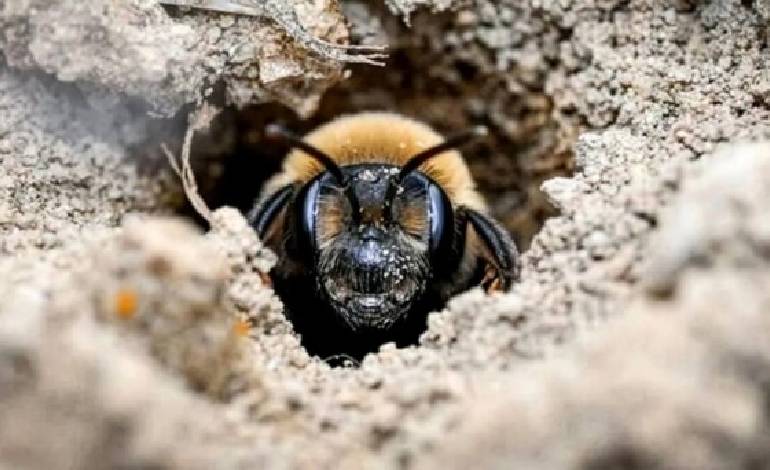
Ithaca: What started as a walk to work has led to one of the largest bee colonies ever recorded. Scientists estimate roughly 5.5 million ground-nesting bees are living under East Lawn Cemetery in Ithaca, New York, in a colony that may be more than 100 years old.
Rachel Fordyce, then working at a Cornell University entomology lab, spotted the bees in spring 2022 while cutting through the cemetery from East Hill Plaza. She collected samples in a jar and brought them to Bryan Danforth, professor of entomology in Cornell’s College of Agriculture and Life Sciences.
The insects were identified as Andrena regularis, known as the regular mining bee. It is a solitary wild species that nests underground and pollinates both crops and wild plants.
Further study revealed the scale. Spread across 1.5 acres of the cemetery’s sandy soil, the colony holds an estimated 3 million to 8 million bees. The midpoint estimate of 5.5 million is comparable to more than 200 honeybee hives and exceeds Manhattan’s human population by more than three times.
“I’m sure there are other large bee aggregations that exist around the world that we just haven’t identified, but in terms of what is in the literature, this is one of the largest,” said Steve Hoge, lead author of the study published April 13 in the journal Apidologie.
To count the bees, researchers used emergence traps. These are small mesh tents that cover less than a square meter of ground and funnel insects into glass jars as they leave their nests. Between March 30 and May 16, 2023, the team placed 10 traps around the cemetery and collected 3,251 insects from 16 species. A. regularis made up the vast majority.
Historical records show the species has been present at East Lawn Cemetery since at least the early 1900s. The cemetery itself was established in 1878. Researchers say the site’s undisturbed sandy soil likely helped the colony persist for decades.
The study also underscores the role of solitary ground-nesting bees in agriculture. A. regularis is a key pollinator for crops like apples, a major New York commodity.
“The research elevates the value of solitary ground-nesting bees and shows just how abundant these bees are, how important they are as crop pollinators, and that we need to be aware of these nest sites and preserve them,” Danforth said.
Scientists added that older cemeteries can act as refuges for biodiversity, sheltering uncommon plants, insects, birds, and mammals in urban areas.