Webb Telescope maps weather, chemistry on ‘Hot Saturn’ 700 light-years away

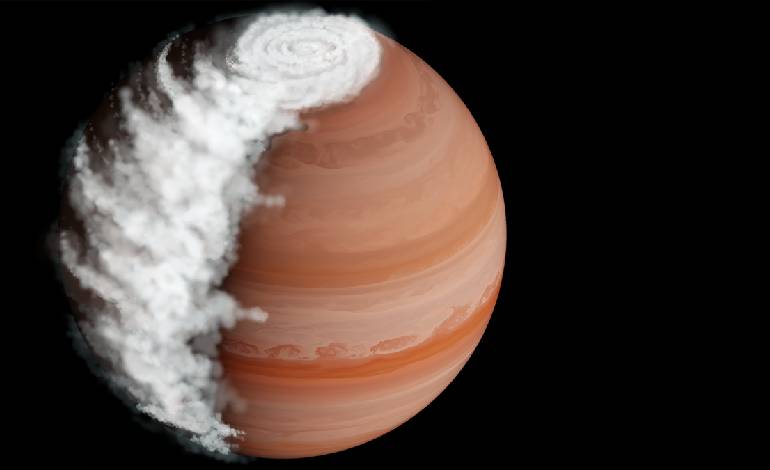
The James Webb Space Telescope has captured weather patterns and a detailed chemical portrait of an exoplanet 700 light-years away, revealing what scientists call a “game changer” for studying distant worlds.
The telescope’s array of highly sensitive instruments was trained on the atmosphere of WASP-39 b, a “hot Saturn” — a planet about as massive as Saturn but in an orbit tighter than Mercury — orbiting a star some 700 light-years away.
Webb’s readings provide a full menu of atoms, molecules, and signs of active chemistry and clouds. The latest data also give a hint of how these clouds might look up close: broken up rather than a single, uniform blanket over the planet.
The findings include the first detection in an exoplanet atmosphere of sulfur dioxide, a molecule produced from chemical reactions triggered by high-energy light from the planet’s parent star. On Earth, the protective ozone layer in the upper atmosphere is created in a similar way. Webb’s instruments also identified water, carbon monoxide, sodium and potassium.
“We observed the exoplanet with multiple instruments that, together, provide a broad swath of the infrared spectrum and a panoply of chemical fingerprints inaccessible until JWST,” said Natalie Batalha, an astronomer at the University of California, Santa Cruz, who contributed to and helped coordinate the research. “Data like these are a game changer.”
The suite of discoveries is detailed in a set of five new scientific papers. The results bode well for Webb’s capability to conduct a broad range of investigations of exoplanets, including probing the atmospheres of smaller, rocky planets like those in the TRAPPIST-1 system.