Tigers breed in Kailadevi Sanctuary after three decades

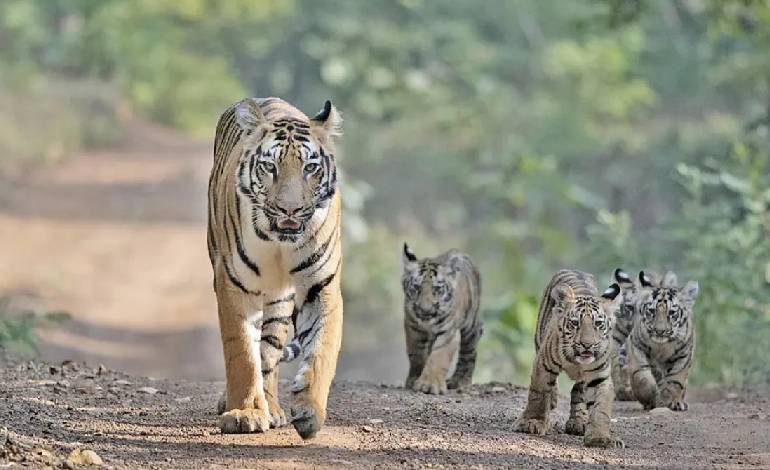
Jaipur: For nearly three decades, Rajasthan’s Kailadevi Wildlife Sanctuary had no documented successful tiger breeding. That has finally changed.
Over the past five years, eight cubs and three adult tigers have been recorded in the sanctuary, raising hopes of a breeding population beyond Ranthambore.
The discovery is detailed in a new study by WWF-India and the Rajasthan Forest Department, released in Jaipur on October 16.
Located in Karauli district and spread across approximately 674 sq km, Kailadevi was established in 1983 and forms the northern extension of Ranthambore Tiger Reserve. For tigers moving out of Ranthambore, it offers a route towards Dholpur-Karauli Tiger Reserve and Madhya Pradesh’s Kuno National Park.
To understand wildlife in Kailadevi, researchers carried out an assessment between November 2023 and February 2024, collecting usable records from 186 camera-trap stations. The cameras recorded 27 mammal species.
Researchers identified 29 individual leopards, with density estimated at 3.65 per 100 sq km. Striped hyenas were photographed most frequently among larger carnivores, followed by wolves and leopards. Jackals, Indian foxes, jungle cats and caracals were also recorded.
“Kailadevi Wildlife Sanctuary is emerging as a vital landscape for tiger conservation, with successful breeding after three decades,” said K C A Arun Prasad, Rajasthan’s Chief Wildlife Warden. He said protecting forests and connecting routes could help establish a second breeding tiger population alongside Ranthambore.
Conservationists say roads, expanding settlements and damage to forest patches can interrupt connectivity. Initiatives by WWF-India and the Forest Department have benefited nearly 8,000 residents across 46 forest-fringe villages around Ranthambore and Kailadevi through livelihood support and cleaner energy options.
Officials noted that eight cubs do not yet establish a secure, self-sustaining population, but show that parts of Kailadevi are providing conditions where tigers can reproduce and raise young.