Fragment of world’s oldest peace treaty found in Turkey

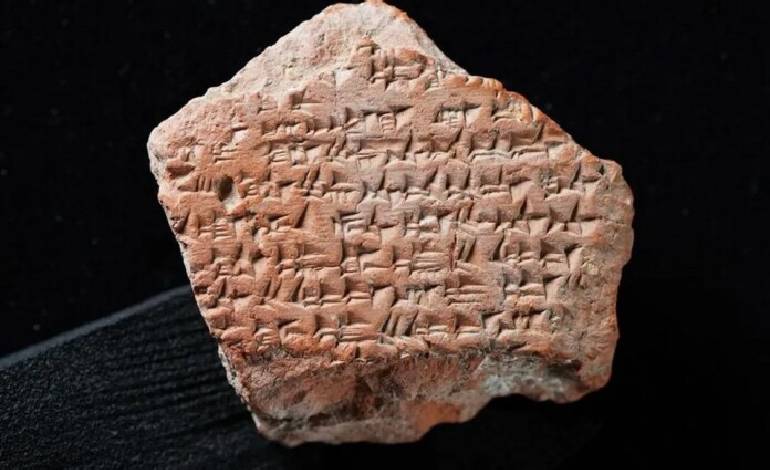
Turkey: A new fragment of the world’s oldest peace treaty has been unearthed at the ancient Hittite capital of Hattusa.
The clay tablet, discovered last year during excavations at the royal palace at Buyukkale and studied for a year before its announcement, contains articles 12-20 of the Peace of Kadesh, Turkey’s Culture Minister Mehmet Nuri Ersoy said.
The words inscribed — “the order fixed for eternity which the Sun God and the God of the Tempest have created for the country of Egypt and the country of Hatti, that is peace and fraternity without leaving place among them to any enmity” — are from Article 14.
The Peace of Kadesh ended a massive chariot battle around 1300 BCE between Egyptian Pharaoh Ramses II and Hittite King Muwatallis II. Tens of thousands fought to a stalemate, and years later Muwatallis’ successor signed a treaty with Ramses.
Until now, the treaty survived in three Akkadian cuneiform copies found in Hattusa in 1906, and one Egyptian hieroglyph version on the walls of Karnak Temple — the only ancient Near Eastern treaty where both sides’ versions survived.
Written in lofty language that the UN says pledges “eternal friendship, lasting peace, territorial integrity, nonaggression, extradition, and mutual help,” the treaty also included a defensive alliance and a surprisingly humane extradition clause: fugitives must be returned without having their homes destroyed, wives seized, or tongues cut out.
A copper copy of the treaty was gifted to the UN by Turkey in 1970 and hangs at its headquarters.
Archaeologists now hope further digs at Buyukkale will uncover more pieces of this fourth cuneiform copy.